
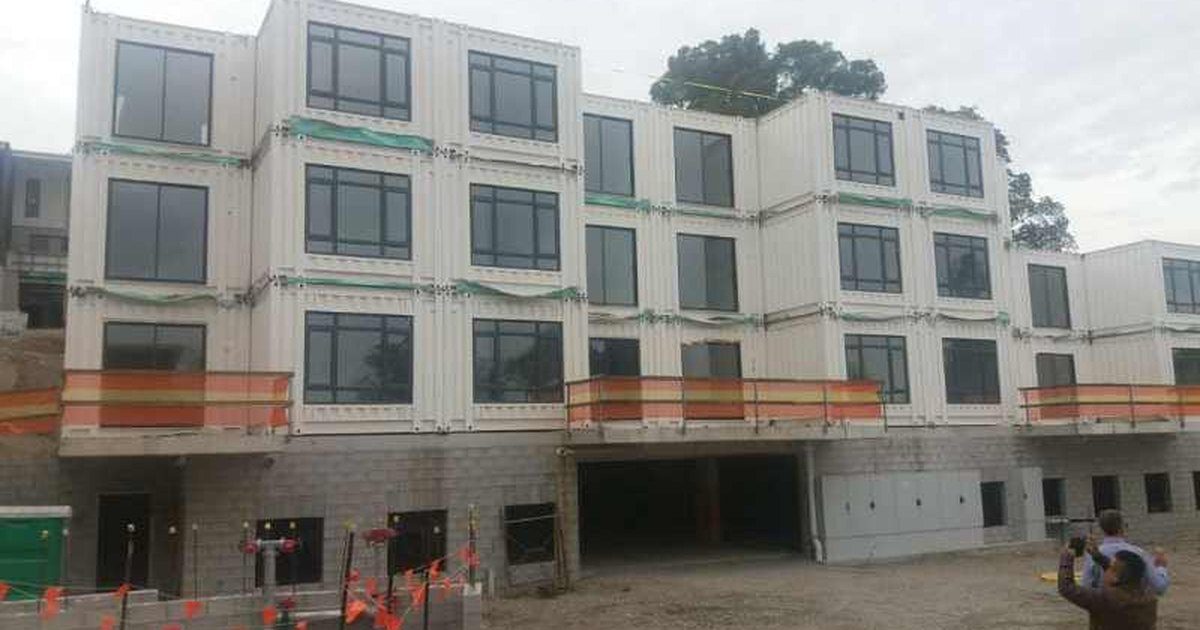
Australia has spent nearly a decade untangling a combustible cladding crisis. After the 2014 Lacrosse fire in Melbourne and the 2017 Grenfell fire in London, every state stood up an audit programme, and thousands of buildings were found wrapped in materials that spread fire up their walls. For any builder or developer buying non-combustible cladding for modular buildings that are fabricated offshore, this is now the first question a certifier, a lender, and an insurer will ask: does the external wall meet the National Construction Code, and where is the evidence?
This guide sets out how the NCC treats external walls and facade materials, which tests decide whether a material is non-combustible, how a performance solution can be used where a material is not deemed-to-satisfy, and what all of this means when the modules arrive pre-cladded from a factory. EcoPrestige supplies turnkey, fully pre-cladded steel-framed modules, so the cladding question sits at the centre of every compliance conversation. The facts below were web-verified in August 2026 against the Australian Building Codes Board. This is general information for builders and developers, not a substitute for a fire engineer or a registered building surveyor on your specific project.
What NCC C2D10 requires for external walls
The core deemed-to-satisfy rule sits in NCC 2022 Volume One, clause C2D10, “Non-combustible building elements.” For buildings of Type A and Type B construction, C2D10(1) requires that external walls and common walls, including every component built into them, be non-combustible. The clause is explicit that this covers the facade covering, the framing, and the insulation, not just the visible skin. Type A and Type B construction captures most Class 2 to Class 9 buildings above single storey, which is exactly the apartment, hotel, student accommodation, aged care, and health and education work where modular is growing fastest.
C2D10 then deems certain materials to be non-combustible without further testing. Concrete, steel, masonry, aluminium, and natural stone are treated as non-combustible under C2D10(5), and plasterboard and fibre-reinforced cement sheeting are accepted as non-combustible equivalents under C2D10(6). A steel-framed module clad in fibre-cement or a compliant sheet system therefore starts from a strong position, because the frame and common sheet linings are already inside the deemed list. The materials that get builders into trouble are the polymer-cored panels and some coatings and membranes that are not on that list and have not been tested.
Two neighbouring clauses matter just as much. C2D14 governs ancillary elements attached to an external wall, things like gutters, downpipes, light fittings, signage, and weatherproofing, and sets limits on how much combustible attachment is allowed. C2D15 covers the fixing of bonded laminated cladding panels, requiring that every layer be mechanically supported or restrained back to the frame rather than only glued. If your module has attachments and a panel system on the outside, both clauses come into scope.
The tests that decide whether cladding is non-combustible
Non-combustibility in the NCC is not a marketing word, it is a laboratory result. The primary test is AS 1530.1, the standard that determines whether a material is non-combustible. A material either passes AS 1530.1 or it does not, and an aluminium composite panel with a polyethylene core fails it because the polymer core is combustible. This is the single most important reason PE-core panels were pulled off Australian facades.
AS 1530.3 sits alongside it and measures early fire hazard indices such as spread of flame and smoke development for materials used inside the building. For the external wall as a whole system, the large-scale test is AS 5113, which classifies a complete wall assembly for its tendency to spread fire vertically up the facade. A wall system that achieves an AS 5113 “EW” classification has been tested as a built-up system, not just as a single sheet. Understanding which test applies to which decision is half the battle: AS 1530.1 judges a material, AS 5113 judges an assembly.
Deemed-to-satisfy or a performance solution using CV3
There are two legitimate compliance routes. The first is the deemed-to-satisfy path, where every external wall material is either on the C2D10 deemed list or has passed AS 1530.1, and the wall simply complies. This is the cleanest route for a modular supplier, because it can be documented once for a standard cladding build-up and repeated across projects.
The second route is a performance solution assessed against the NCC performance requirements. Verification Method CV3, “Fire spread via external walls,” is the pathway that uses an AS 5113 result to demonstrate that a wall system controls vertical fire spread. CV3 is aimed at higher-risk buildings, including those over 25 metres effective height and Class 2, 3, and 9 buildings, and it usually pairs the facade classification with sprinkler protection and other measures. One caution the Australian Building Codes Board makes plain: an AS 5113 EW classification on its own does not automatically prove NCC compliance. It is evidence that a fire engineer uses inside a broader performance solution, signed by a suitably qualified engineer and accepted by the building surveyor. For most modular projects the deemed-to-satisfy route is simpler, and a performance solution is reserved for the taller or more complex builds.
Why non-combustible cladding for modular buildings needs an evidence trail
When a module is fabricated overseas, the cladding is fixed to the frame in the factory before it ever reaches site. That is a programme advantage, because the wall is built in controlled conditions, but it shifts the compliance work forward. The certifier cannot inspect the cladding being installed on site, so the evidence has to travel with the module. This is where the NCC evidence of suitability framework does the heavy lifting. Under NCC Part A5, a builder can rely on a CodeMark certificate of conformity, a certificate of accreditation, a professional engineer’s certificate, a Registered Testing Authority report such as an AS 1530.1 or AS 5113 result, or other documentary evidence to show the surveyor that the material and the system meet the code.
In practice, that means the cladding specification, the test reports for the sheet and the coating, the fixing details demonstrating C2D15 compliance, and the ancillary element schedule under C2D14 all need to be packaged and handed to the building surveyor as part of the module documentation. EcoPrestige works inside a clear scope split on this. EcoPrestige supplies pre-cladded steel-framed modules into the licensed head contractor’s scope, and the head contractor, as the registered building practitioner and builder of record, holds the building permit and carries responsibility for the completed building’s compliance, including acceptance of the facade evidence by the appointed surveyor. The modules are engineered to Australian standards and manufactured offshore, and the evidence of suitability for the cladding is assembled so the surveyor can sign it off. It is worth reading the companion guides on evidence of suitability for modular buildings and fire-rated modular buildings and FRL compliance, because passive fire separation and external wall combustibility are related but separate obligations.
State cladding audits and bans you still have to clear
Even with a compliant NCC build-up, every state runs its own overlay, and a new modular building is not exempt from scrutiny just because it is new. In Victoria, Cladding Safety Victoria has assessed more than a thousand buildings and the Victorian Building Authority audits cladding on new and existing work, backed by a large state rectification programme. In New South Wales, the Design and Building Practitioners Act 2020 requires registered practitioners to make compliance declarations, which in practice makes a PE-core panel almost impossible to justify without a performance solution, and the Cladding Product Safety Panel and Project Remediate programme sit behind it. Queensland runs the Safer Buildings programme through the Queensland Building and Construction Commission with a combustible cladding checklist. The Australian Capital Territory, Western Australia, and South Australia each have their own audit or evidence regime, with South Australia requiring documented non-combustibility evidence under Ministerial Building Standard MBS 002.
The practical lesson is that the documentation you assemble for the NCC is the same documentation these state programmes want to see, so building it once, properly, at the factory stage is far cheaper than retrofitting an evidence trail later. Getting the cladding evidence right also protects the durability story, which is why the corrosion protection guide and the structural engineering and steel certification guide are worth reading alongside this one.
How EcoPrestige pre-cladded modules address the cladding question
EcoPrestige builds turnkey, fully pre-cladded modular units on a galvanised steel frame in a 50,000 square metre in-house production facility, and delivers them roughly 30 per cent faster than typical modular suppliers. Because the cladding is fixed in the factory, the wall build-up is consistent from module to module, which makes the evidence of suitability package repeatable rather than a one-off argument on every job. Units are engineered to suit NCC Class 1a, 2, 3, and 9b outcomes, come with an Occupancy Certificate pathway, and carry a 12-year structural warranty and a 12-month materials warranty. Buyers can engage EcoPrestige three ways: modular supply only, supply plus EcoPrestige installation, or a design and build coordinator role under AS 4300.
None of that removes the head contractor’s role. The registered building practitioner still holds the permit, still appoints the surveyor, and still signs the declarations their state requires. What the pre-cladded module does is bring the external wall into a controlled, documented, factory-verified condition so the surveyor has a clean evidence trail to accept. For a deeper look at how the modules are dimensioned and specified, the architects’ design and specification guide and the building services connection guide show how the facade sits within the wider module, and the broader offsite construction overview and the NCC 2022 compliance builders’ guide put cladding in context with the full compliance picture.
One note on editions. NCC 2022 remains the referenced framework in New South Wales, Queensland, and the Australian Capital Territory until 1 May 2027, while NCC 2025 has been in force in Victoria since 1 May 2026. The non-combustible external wall structure carries through both editions, but always confirm the edition adopted in your project’s state before you specify.
If you are scoping a Class 2 to 9 modular project and want the cladding evidence handled properly from the factory stage, request the EcoPrestige builder pack or download the product brochures to see the specifications and warranty terms in full.
Frequently asked questions
Does NCC C2D10 require all modular external walls to be non-combustible?
For Type A and Type B construction, which covers most Class 2 to 9 buildings above single storey, C2D10 requires external and common walls, including the facade covering, framing, and insulation, to be non-combustible. Lower-risk classes and some smaller buildings have different provisions, so the requirement depends on the building’s class and Type of construction, confirmed by your building surveyor.
What test proves cladding is non-combustible in Australia?
The material test is AS 1530.1, which determines whether a material is non-combustible. For a complete external wall assembly, AS 5113 classifies the system for vertical fire spread and produces an EW classification. Aluminium composite panels with a polyethylene core fail AS 1530.1 because the polymer core is combustible.
Can a combustible cladding still be used on a modular building?
Sometimes, through a performance solution rather than the deemed-to-satisfy path. Verification Method CV3 uses an AS 5113 result to show a wall system controls fire spread, usually combined with sprinklers and other measures, and it must be assessed by a fire engineer and accepted by the surveyor. An AS 5113 classification on its own does not prove NCC compliance.
Who is responsible for cladding compliance when modules are made offshore?
The licensed head contractor, as the registered building practitioner and builder of record, holds the building permit and carries responsibility for the completed building, including acceptance of the facade evidence by the appointed surveyor. EcoPrestige supplies pre-cladded steel-framed modules, engineered to Australian standards and manufactured offshore, with the evidence of suitability documentation packaged so the surveyor can sign it off.
How do offshore-fabricated modules satisfy a certifier on cladding?
Through the NCC Part A5 evidence of suitability framework. The certifier accepts documentary evidence such as a CodeMark certificate of conformity, a certificate of accreditation, a professional engineer’s certificate, or a Registered Testing Authority report like an AS 1530.1 or AS 5113 result, together with fixing details under C2D15 and the ancillary element schedule under C2D14. Because the cladding is fixed in the factory, this evidence is assembled up front and travels with the module.
Cladding choice also affects the building’s thermal envelope. See how the same modules meet NCC 2022 energy performance in the 7-star NatHERS and Section J compliance guide. Read the 7-star NatHERS and Section J compliance guide.