
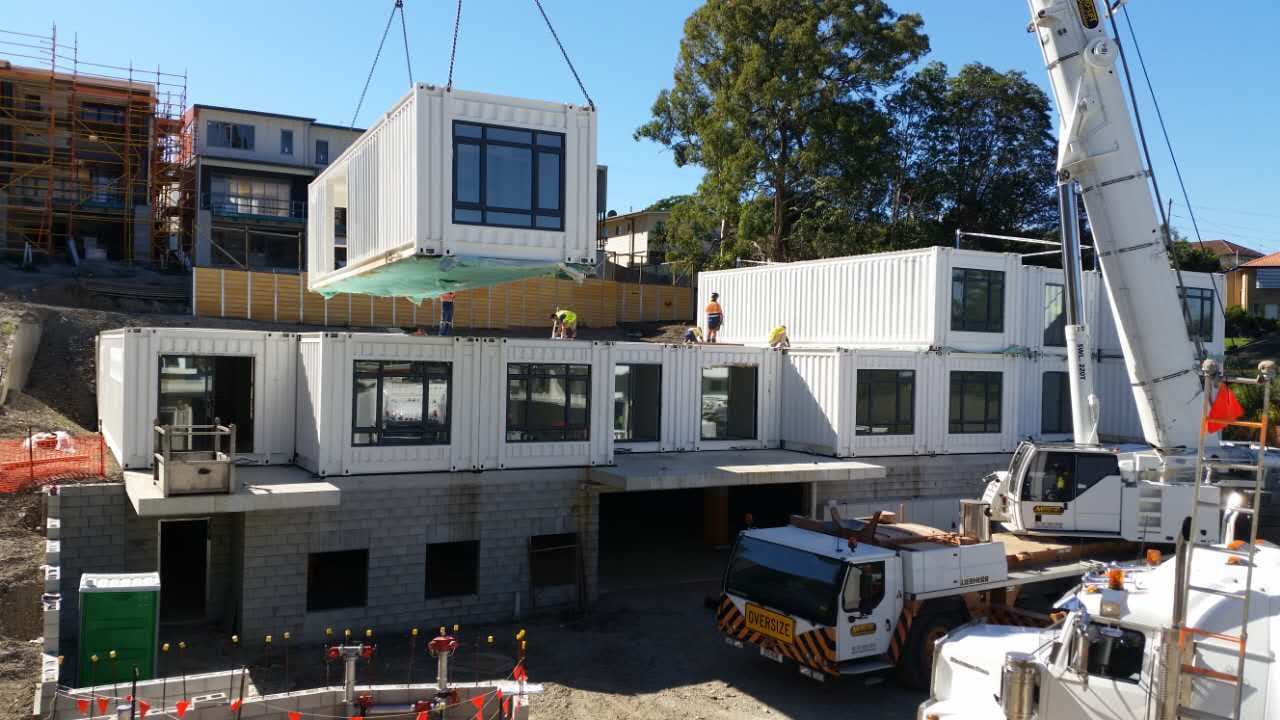
For most Australian builders and developers, the hardest part of an offshore modular project is not the engineering. It is the money. Offshore modular construction finance does not behave like a normal construction loan, because you are paying a factory on the other side of the world for modules that will not sit on your land until late in the program. This guide explains progress payments, lender security, deposit risk and the tools that make an imported modular build bankable.
It sits alongside our companion guide on warranty, defects liability and insurance for modular buildings, and our 7-step offshore procurement risk playbook. Compliance answers whether a building is legal. Warranty answers who is liable if it fails. Finance answers a third question that stops many projects before they start: how do you pay for it safely.
Why offshore modular breaks the standard construction loan
A conventional Australian construction loan is built around one assumption. Value is created on your site, in stages, and the lender can see it. The bank releases money in drawdowns as work is completed on the land it holds as security. If the borrower defaults, the lender takes the land, and whatever has been built on it, and sells the lot.
Offshore modular flips that assumption. A large share of the build value is created in a factory overseas, weeks or months before a single module is craned onto your slab. During that window the lender is being asked to fund an asset it cannot see, cannot inspect on your title, and cannot repossess by taking the land. That mismatch, not the modular method itself, is what makes some banks hesitate. Understanding it is the first step to solving it.
How Australian construction progress payments normally work
Standard construction lending in Australia releases funds against a fixed schedule of progress payments, each tied to a stage completed on site. A typical residential drawdown schedule runs deposit, base or slab, frame, lock-up, fixing and practical completion. The lender, or a quantity surveyor acting for it, inspects each stage before releasing the next payment. The borrower never gets money ahead of built value.
This model protects the lender well for brick-and-timber builds. It protects it poorly for modular, because it has no stage for work done in a factory. If the schedule only pays for what is visible on your land, and 60 to 70 per cent of the building is manufactured before delivery, the schedule and the cashflow are out of step from day one. The build needs money early. The standard loan releases it late.
The offshore payment gap: paying a factory before modules land
Offshore manufacturers, like most factories, work to a deposit-and-milestone payment structure. A meaningful deposit is usually required to start engineering and secure a production slot, with further payments as the modules are framed, clad, fitted out and readied for shipping. Payment terms are commonly tied to Incoterms and to shipping, so a large balance can fall due at or near the point the modules leave the port of origin.
The result is a genuine gap. The factory wants to be paid as it builds. The Australian lender wants to pay only as modules are installed and inspected here. Bridging that gap is the core problem in offshore modular construction finance, and it is solved with security instruments and a payment structure that gives the lender comfort over goods it cannot yet see on your land.
Lender security tools: PPSR, bank guarantees and letters of credit
Three tools do most of the work of making an offshore modular payment safe.
The first is the Personal Property Securities Register, or PPSR. Until a module is fixed to your land it is legally goods, not a fixture, which means a party can register a security interest over it. A builder, developer or financier who has paid for modules can register on the PPSR to protect priority over those goods if a counterparty becomes insolvent before delivery. This is the mechanism that lets money follow the asset while the asset is still mobile.
The second is the bank guarantee. Instead of releasing cash to the factory, or in addition to it, a bank guarantee gives the supplier certainty of payment on agreed milestones while the funds stay controlled by the bank. It converts a trust problem into a documented instrument, and it is a standard part of head-contract security in Australian construction.
The third is the documentary or standby letter of credit, common in international trade. It lets an issuing bank pay the offshore supplier only when defined documents, such as proof of shipment or a factory inspection certificate, are presented. The supplier is paid against evidence, not promises, and the buyer is not exposed to paying for goods that never ship.
CommBank’s new Assessed Manufacturer panel (2026)
CommBank has launched an Assessed Manufacturers list for modular builders, a vetted panel that changes how much a buyer can draw before the home reaches site. Building with a CommBank Assessed Manufacturer lets a borrower access progress payments up to 80% of contract value, or 150% of land equity, whichever is lower, before the module leaves the factory. Outside that panel, progress payments stay capped at 60% of contract price or 120% of land equity. For a buyer on a fixed-price contract up to $1.5 million, that is the difference between self-funding most of the build upfront and having real finance behind the factory stage. Oly Homes was among the first modular builders to qualify. EcoPrestige is reviewing what the panel requires and will update this page once that is confirmed.
Structuring milestone payments across factory production
The cleanest way to close the gap is to align the payment schedule with verifiable factory stages rather than site stages alone. A milestone structure might release payment against a signed shop-drawing approval, a photographed frame-complete stage, a cladding-and-fit-out stage, a pre-shipment factory inspection, delivery to site, and final installation with sign-off. Each milestone is evidenced, and each release is smaller than a single lump-sum deposit would be.
Independent factory inspection matters here. A pre-shipment inspection by an Australian-facing quality party turns a factory milestone into something a lender or quantity surveyor can accept as a drawdown trigger. This is one reason Australian engineering and quality oversight of offshore manufacture is a commercial feature, not just a technical one. It makes the money moveable. Our guide on how to evaluate a modular supplier sets out the checks that give inspectors and lenders that confidence.
Incoterms and when title and risk pass
Incoterms 2020 are the international rules that define, for each shipment, who arranges and pays for freight and insurance, and the exact point at which risk passes from seller to buyer. Common terms include EXW at the factory gate, FOB at the port of origin, CIF with cost and insurance to the destination port, and DAP delivered to a named place. The term you agree changes who carries the modules if they are damaged in transit, and when.
Two points matter for finance. First, risk passing is not the same as title passing, and both should be defined in the supply contract so the PPSR position and the insurance cover line up. Second, marine cargo insurance should cover the modules for their full value across the exact leg where risk sits with your side. A financed project with an insurance gap over the sea leg is a financed project with an uninsured hole.
Valuation timing and the “as if complete” question
Lenders lend against valuations, and modular raises a timing question. Much of the value is complete before it reaches the site, yet a valuer inspecting your land early sees only a slab. Some lenders address this with an “as if complete” or “on completion” valuation, funding against the finished value on the expectation that the modules will be installed. Others now offer prefab-aware construction products that release a progress payment before the home is on site, precisely to bridge the manufacturing window.
The practical lesson is to raise the offshore method with the lender at the start, not after the deposit is due. A build that is costed accurately up front and presented with a clear milestone and security structure is far easier to fund than one that surprises the credit team halfway through.
Where EcoPrestige’s three offerings fit
EcoPrestige structures work through three offerings, and each carries a different finance shape. Modular Supply delivers turnkey, fully pre-cladded modules to your site, and the head builder holds the site contract and its progress payments. Supply plus EcoPrestige install adds the craning and connection, moving more of the on-site milestone into one line. The design-and-build coordinator model, run to AS 4300, wraps design, manufacture and delivery under a coordinated contract that a lender can read as a single scope.
Across all three, the manufacturing runs through a 50,000 square metre in-house production facility under Australian engineering and quality oversight, and the delivered building comes with an Occupancy Certificate and EcoPrestige’s 12-year structural warranty and 12-month materials warranty on the supplied system. Those features do not replace the head builder’s statutory obligations, but they give a financier a documented, inspectable chain from factory to finished asset. For a fuller picture of who carries what, see who builds the Australian building and our commercial modular guide.
A practical finance checklist for builders and developers
Before you commit a deposit on an offshore modular project, work through the essentials. Talk to your lender about the offshore method before signing, and ask whether they offer an on-completion valuation or a prefab-aware drawdown. Agree a milestone payment schedule tied to evidenced factory stages, not a single large deposit. Register your interest on the PPSR over the modules while they remain goods. Use a bank guarantee or letter of credit rather than uncontrolled cash transfers offshore. Lock the Incoterm and confirm marine cargo insurance covers the full value across the sea leg. Require an independent pre-shipment inspection as a payment trigger. Confirm the supply contract separates risk and title clearly. Do these things and the offshore payment gap becomes a managed structure rather than an open exposure.
Offshore modular can deliver faster programs and strong value per square metre, but only if the money is structured as carefully as the building. Get the finance right first, and the rest of the project follows.
Frequently asked questions
Can you get a construction loan for an offshore modular build in Australia?
Yes. The challenge is timing, not eligibility. Standard construction loans release funds against on-site stages, while offshore modular needs money during factory production. It is solved by raising the method with the lender early and agreeing an on-completion valuation or prefab-aware drawdown, backed by a milestone payment schedule and security over the modules.
How do you protect a deposit paid to an offshore modular factory?
Use documented instruments rather than uncontrolled cash. A bank guarantee or a documentary or standby letter of credit pays the supplier only against agreed milestones or shipping documents. Registering a security interest on the PPSR over the modules protects your priority over those goods if a counterparty becomes insolvent before delivery.
What is the PPSR and why does it matter for modular finance?
The Personal Property Securities Register lets a party register a security interest over goods. Until a module is fixed to your land it is legally goods, not a fixture, so a builder, developer or financier who has paid for modules can register to protect priority. It is the main tool that lets money safely follow modules that are still mobile.
How should offshore modular payments be structured?
Align payments with verifiable factory stages such as shop-drawing approval, frame complete, cladding and fit-out, a pre-shipment inspection, delivery and installation. Each milestone is smaller than a lump-sum deposit and each release is evidenced, which spreads risk and gives lenders and quantity surveyors something they can inspect and accept.
Do Incoterms affect how a modular project is financed?
Yes. Incoterms 2020 define who pays for freight and insurance and the point at which risk passes from seller to buyer. The chosen term shapes who carries damage in transit and when, so it should line up with the title position in the supply contract and with marine cargo insurance covering the full value across the sea leg.
Ready to plan an offshore modular project with a clear supply and finance structure? Explore the EcoPrestige brochures or reach the team through the contact page.