
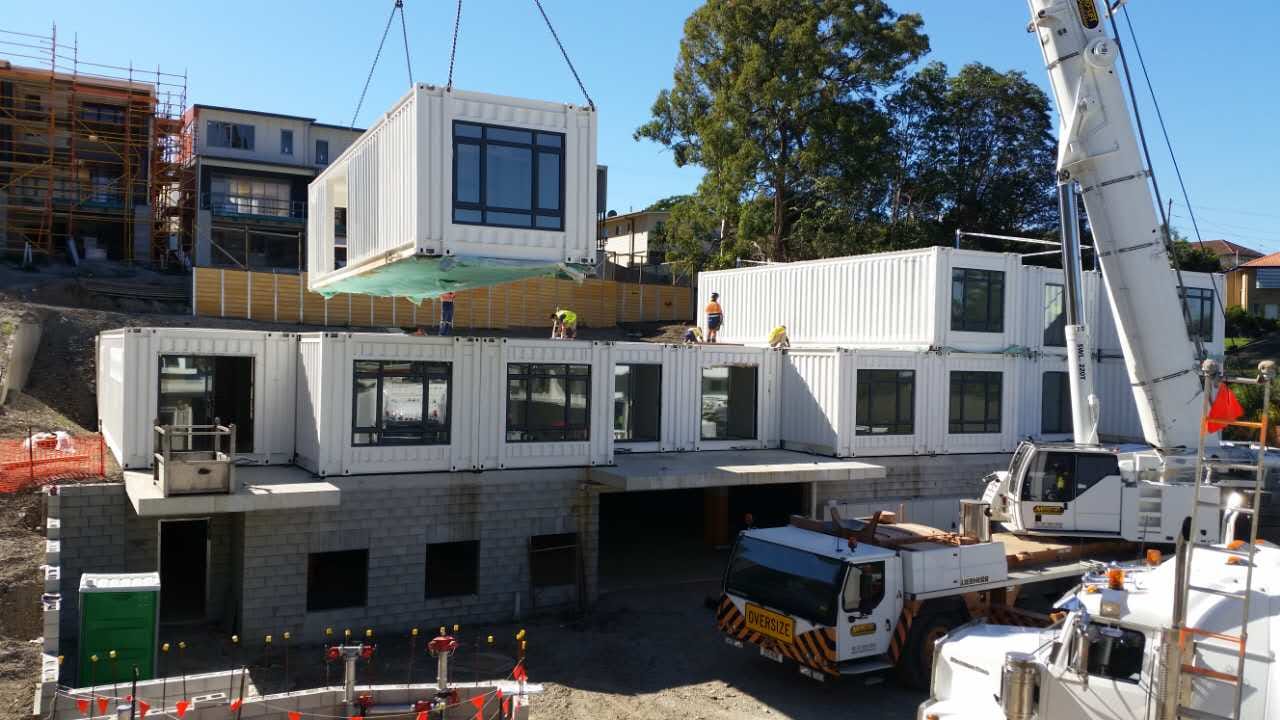
Getting a modular building manufactured is only half the job. The part that quietly sinks programmes and budgets is the last leg: moving finished modules over public roads and craning them onto the slab. Craning modular buildings is where transport law, crane engineering, ground conditions and site sequencing all collide on a single day, and where a missed permit or an undersized crane can cost a builder far more than the lift itself. This guide walks Australian builders and developers through transport, permits, crane selection, lift planning and install sequencing so the delivery day is boring, which is exactly what you want it to be.
If you have already read our guide on importing modular buildings into Australia, think of this as the next chapter. Importing gets the modules to an Australian port or yard. This guide gets them from the yard to the crane hook and onto your foundations.
Why transport and craning is a separate project risk
A completed module is large, heavy and finished. It is not a shipping container full of loose parts. It has glazing, cladding, joinery and services already installed, so it cannot be roughly handled or stacked without care. That changes the risk profile in three ways. The load is oversize and often overmass, so it needs road permits. The lift is heavy and awkward, so it needs an engineered crane plan. And the module is a finished product, so damage in transit or in the lift is expensive to repair. Treat transport and craning as their own work package with their own budget line, not as an afterthought bolted onto the manufacturing quote.
Transport: oversize and overmass permits
Most finished modules exceed standard vehicle width, and many exceed standard mass limits once loaded on a trailer. In the states and territories that operate under the Heavy Vehicle National Law, oversize and overmass movements are managed by the National Heavy Vehicle Regulator through Class 1 access permits and notices. You apply for the route, and the regulator and the relevant road managers set the conditions. Western Australia and the Northern Territory sit outside the Heavy Vehicle National Law, so movements there are permitted through Main Roads Western Australia and the Northern Territory road authority respectively. Build permit lead time into your programme early, because road manager consent for a wide load on a constrained route is not instant.
Permits are only part of it. The route itself has to physically accept the load. Bridge capacity, overhead clearances, roundabouts, level crossings, tight urban corners and low-hanging services can all stop an oversize trailer that looked fine on a map. A route survey by the transport operator before the move is cheap insurance. Wide loads also trigger pilot or escort vehicle requirements, and in some cases police escort, depending on the dimensions and the jurisdiction. Loads must be restrained in line with the principles in the National Heavy Vehicle Load Restraint Guide, and everyone in the chain, from the consignor to the driver, carries duties under Chain of Responsibility. A builder who books the transport is part of that chain, not a bystander.
Site access and set-down
The crane and the trailers need somewhere to work. Before delivery day, confirm that a truck long enough to carry a module can physically enter, turn and leave the site. Confirm there is a firm, level laydown area if modules will be set down before lifting rather than lifted straight off the trailer. And confirm the crane can be positioned where its reach and rated capacity actually cover the set-down points. On tight infill sites this is often the hardest constraint, and it is far better discovered on a plan than on the morning of the lift with three trucks queued in the street.
Craning: crane selection and lift planning
Crane selection is an engineering decision, not a hire-desk decision. Mobile cranes used for this work are designed to the AS 1418.5 standard, and their safe use is governed by the AS 2550 series. The crane has to lift the heaviest module at the largest radius it will ever work at, with margin, because a crane’s rated capacity falls sharply as the load moves further from the machine. Getting this wrong is the classic modular delivery failure: the crane can lift the module close in, but not out at the far corner of the building where it actually has to go.
A proper lift study answers the real questions before anyone books a crane. What is the verified weight and centre of gravity of each module. What is the crane position, radius and rated capacity at that radius. What lifting gear, spreader beams and lifting points are engineered for the module. What is the ground bearing pressure under the crane, and does the crane pad or outrigger mats spread the load enough for the actual soil. Craning modular buildings safely depends on that ground assessment as much as on the crane itself, because a crane that sinks an outrigger is a crane that can tip.
The people matter too. In Australia, crane operation, dogging and rigging are high risk work that require the relevant high risk work licences, and lifting a load like a module is high risk construction work that needs a Safe Work Method Statement. Lifting over people is controlled through exclusion zones, and the lift plan should keep the load off any area where workers cannot be cleared. None of this is optional, and a delivery partner who cannot show you the licences and the lift plan is a partner to avoid.
Sequencing and installation
Once a module lands, the work is not over. Modules have to be placed in the right order so that access for the crane is not blocked by modules already set. Each unit is levelled, connected to the footings or podium, and fixed to adjacent modules. Inter-module joints are weatherproofed and services are connected across the joins. On hybrid builds, where modules sit against a concrete core or a ground floor built conventionally, the interface between the two systems needs to be detailed and sequenced in advance. Good sequencing is what lets a multi-level modular building close up to weathertight in days rather than weeks, and it is planned long before the first truck arrives.
How EcoPrestige de-risks delivery
EcoPrestige supplies turnkey, fully pre-cladded modular units, which means the modules arrive finished and the delivery day is about placement, not fit-out. Builders can engage us three ways: modular supply only, supply plus EcoPrestige installation, or a design and build coordinator role under AS 4300. That flexibility matters for transport and craning, because a builder who wants to control the crane and the trucks can take supply only, while a builder who wants the lift managed can hand the whole set-down and install package across.
Because our modules are engineered and manufactured in a 50,000 square metre in-house production facility and delivered pre-finished, programmes typically run around 30 percent faster than typical modular suppliers once site works and delivery are coordinated well. Completed buildings are delivered to NCC Class 1a, 2, 3 and 9b compliance with an Occupancy Certificate, and are backed by a 12-year structural warranty and a 12-month materials warranty. You can see the full delivery sequence on our process page, review the engineering approach on our offsite construction page, and download scope and pricing from the builder pack.
For remote and regional projects, where transport distance and site access are the dominant risks, our workforce accommodation procurement guide and our China to Australia procurement guide cover the logistics and risk-control questions builders should ask before committing.
Frequently asked questions
Do I need a permit to transport a modular building on Australian roads?
In most cases yes. Finished modules are usually oversize and often overmass, so they need a Class 1 access permit or notice. In states and territories under the Heavy Vehicle National Law this is handled by the National Heavy Vehicle Regulator. Western Australia and the Northern Territory permit these movements through their own road authorities. Apply early, because route approval on constrained roads takes time.
What size crane do I need to install modules?
It depends on the heaviest module, the largest working radius and the crane position, not just the module weight. A crane’s rated capacity drops as the load moves further away, so the crane must be sized for the worst-case lift with margin. This is settled by an engineered lift study, not by picking a crane off a rate card.
Who is responsible if something goes wrong in transport?
Under Chain of Responsibility, everyone who influences the transport task carries duties, including the party that consigns or receives the load. A builder who books an oversize movement is part of that chain and should confirm the transport operator holds the right permits, restraint and escorts before the load leaves the yard.
What ground conditions do cranes need on site?
Mobile cranes exert very high loads through their outriggers, so the ground has to be assessed and, where needed, a crane pad or outrigger mats used to spread the load. Soft, filled or wet ground can fail under an outrigger and cause the crane to tip, so ground bearing capacity is part of every lift plan.
Can EcoPrestige manage transport and installation, or supply only?
Both. EcoPrestige offers modular supply only, supply plus installation, or a design and build coordinator role under AS 4300. Builders who want to run their own crane and transport can take supply only, while those who want the lift and set-down managed can hand across the full delivery package.
Plan the last leg first
The modules will be built. The question that decides your programme is whether they can be moved and lifted onto your site cleanly. Sort the permits, the route, the crane study and the ground assessment before you lock a delivery date, and craning modular buildings becomes a routine day rather than a crisis. Talk to EcoPrestige early and we will help you plan the delivery around your site, not the other way around.