
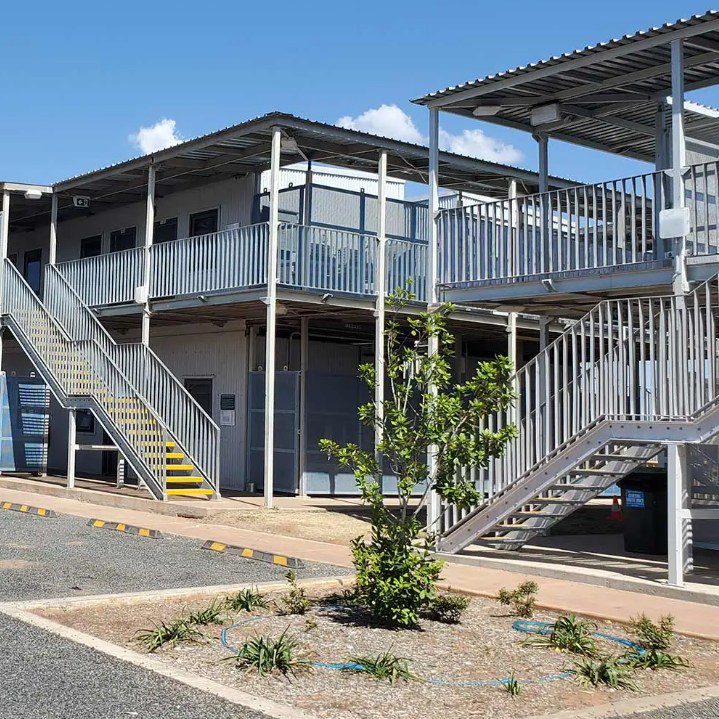
The 2026 Defence Strategic Review committed to $50+ billion in Defence estate infrastructure investment through 2034, with substantial allocation to RAAF base modernisation, Army barracks expansion, and Royal Australian Navy fleet base support. For Australian-licensed head contractors and modular suppliers with security-cleared workforce capability, the Defence procurement window is materially different from civil school / accommodation procurement — and the modular delivery model is increasingly favoured for accelerated estate upgrades.
Where Defence Modular Spend Concentrates
RAAF Modernisation
- RAAF Williamtown (NSW) — F-35A operations base, accommodation + maintenance facility expansion
- RAAF Edinburgh (SA) — P-8A Poseidon + MQ-4C Triton operations, accommodation expansion
- RAAF Tindal (NT) — northern force posture, accommodation + facility expansion as part of $1.7B AUKUS-aligned upgrade
- RAAF Amberley (QLD) — F-35A + Super Hornet operations, accommodation and training facility expansion
Army Barracks
- Robertson Barracks (NT) — 1st Brigade expansion as part of northern force posture
- Larrakeyah Barracks (NT) — Royal Australian Navy + Army, accommodation modernisation
- Lavarack Barracks (Townsville) — 3rd Brigade expansion + housing
- Holsworthy Barracks (NSW) — Special Forces capability expansion
Royal Australian Navy
- HMAS Stirling (WA) — fleet base support, AUKUS-aligned expansion
- HMAS Cairns (QLD) — Patrol Boat operations support
Defence Compliance + Procurement Stack
Defence procurement has compliance layers that civil procurement does not:
- Defence Construction (DEFCON) tendering — Defence Estate and Infrastructure Group (EIG) manages procurement; contracts let through Capital Facilities and Infrastructure (CFI) panel
- Security clearance requirements — Baseline Vetting (BV), Negative Vetting (NV1, NV2), Positive Vetting (PV) for workforce accessing classified facilities
- ASIO-T4 facility certification for classified work environments
- NCC compliance — Class 1b, 3, 5, 9b, 10a depending on facility type
- Defence Engineering Standards (DES) overlay on civil NCC compliance — additional structural, fire, services requirements
- Defence Acoustic Specifications for accommodation, training, and operational facilities
- Cyber-secure infrastructure requirements for IT-enabled facilities
Why Modular Wins Defence Programmes
Three factors that favour modular delivery for Defence:
- Accelerated programme — Defence Strategic Review commits explicitly call out infrastructure delivery timelines as a strategic constraint; modular 6-9 month programmes outperform traditional 18-30 month builds
- Standardised typologies — Defence accommodation, training, and admin facilities have repeating typologies that benefit from modular standardisation
- Remote location logistics — many Defence bases (Tindal, Larrakeyah, RAAF Curtin, RAAF Learmonth) are in remote locations where modular delivery’s controlled-environment factory build mitigates site labour scarcity
Cost Benchmarks for Defence Modular Delivery
Defence modular typologies command a premium over civil benchmarks due to compliance layer:
- SLB (Single Living-In Accommodation) units (Class 1b): $3,200-$4,500/m² supply
- Married Quarters (Class 1a): $2,800-$3,800/m²
- Training facility (Class 9b): $3,500-$5,200/m²
- Administration (Class 5): $3,200-$4,400/m²
- Maintenance / Workshop (Class 8): $3,800-$5,500/m²
- Mess + Recreation (Class 3): $3,800-$5,800/m²
Premium reflects DES compliance, security clearance contracting overhead, and remote-base logistics for northern bases.
Northern Force Posture Implications
The 2026 Defence Strategic Review accelerated northern Australia force posture, concentrating spend across:
- RAAF Tindal accommodation, hardstand, fuel infrastructure (the largest single base expansion since the 1980s)
- Robertson Barracks expansion and force concentration
- Larrakeyah Barracks accommodation modernisation
- RAAF Curtin (WA) bare-base activation
- RAAF Learmonth (WA) bare-base activation
For these northern bases, cyclonic compliance (AS 1170.2 Region C/D), seismic detailing, and remote logistics all apply on top of Defence compliance overlay.
What EcoPrestige Provides for Defence-Aligned Builders
- NCC Class 1a/1b/3/5/8/9b/10a typologies pre-engineered with DES overlay capability
- Cyclonic + seismic detailing for northern base delivery (Region C/D AS 1170.2; kp 0.11 AS 1170.4)
- Remote-base discharge and logistics for Tindal, Larrakeyah, Curtin, Learmonth
- QA documentation and producer-statement chain pre-built for Defence tender attachment
- Line-item pricing aligned with Defence procurement benchmark bands
Note: EcoPrestige supplies modular systems through head-contractor partnerships. Security-cleared workforce, ASIO-T4 facility certification, and classified-environment work require the head-contractor of record to hold relevant clearances. EcoPrestige’s factory work occurs in non-classified manufacturing environments.
FAQ
How big is Defence’s modular infrastructure spend in Australia through 2034?
The 2026 Defence Strategic Review commits to $50+ billion in Defence estate infrastructure through 2034, with substantial allocation to RAAF modernisation, Army barracks, and RAN fleet base support. Modular delivery is increasingly favoured for accelerated programmes.
What are the major Defence base modular expansion programmes?
RAAF Williamtown / Edinburgh / Tindal / Amberley; Robertson / Larrakeyah / Lavarack / Holsworthy Barracks; HMAS Stirling / Cairns. Plus northern force posture expansion at Tindal, Curtin, Learmonth.
What compliance applies to Defence modular delivery?
NCC compliance plus Defence Engineering Standards (DES) overlay plus Defence Acoustic Specifications plus security clearance requirements for workforce plus ASIO-T4 facility certification for classified environments.
What does Defence modular accommodation cost?
SLB units: $3,200-$4,500/m² supply. Married Quarters: $2,800-$3,800/m². Training facility: $3,500-$5,200/m². Premium over civil benchmarks reflects DES compliance and security contracting overhead.
Can a civil modular supplier work on Defence projects?
Through head-contractor partnerships where the head contractor of record holds security clearances and classified-environment certification. Modular factory work occurs in non-classified manufacturing environments; on-site installation in classified zones requires cleared workforce.
Next Steps for Defence Modular Procurement Builders
For Australian-licensed head contractors with Defence clearance pursuing RAAF / Army / Navy modular expansion procurement — see our technical brochures or contact us for a confidential discussion.
Related: Pilbara workforce accommodation guide, Karratha + Pilbara compliance / cost / delivery, NT modular construction.
Get the EcoPrestige Builder Pack
Commercial price and supply guide plus the developer and builder scope overview. The two documents builders, developers and project managers ask for first. Instant access.
Prefer to talk direct? Email info@ecoprestige.com.au.