
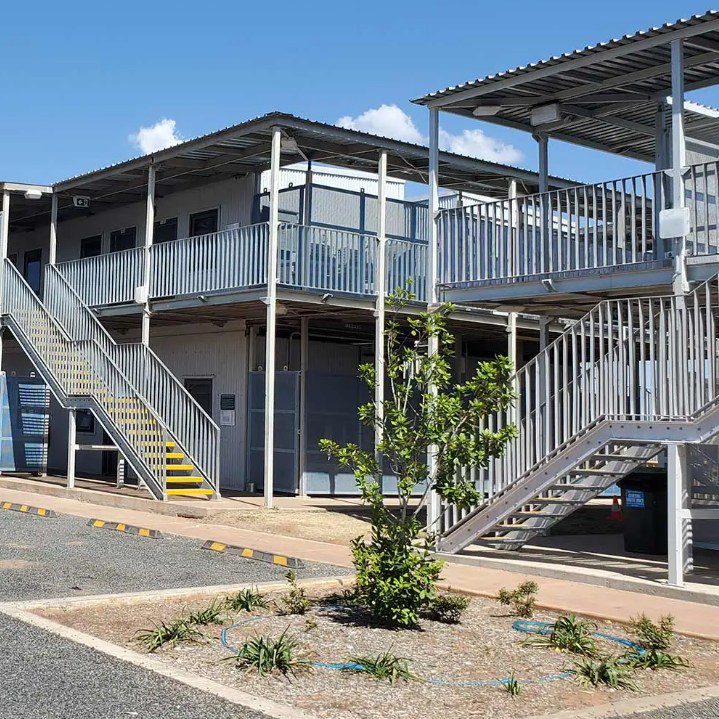
Rio Tinto’s $100 million Pilbara essential-worker accommodation programme is now in market through Sodexo’s 7-year facilities-management partnership, with parallel programme spend from BHP ($50M Port Hedland) and Fortescue announced through 2026. For modular workforce-accommodation suppliers and Pilbara-licensed builders, the procurement window is open — but the spec sheet is materially different from the camp-style accommodation that dominated the prior cycle.
This guide breaks down what the retention-driven specifications look like, why the SPQ (Single-Person Quarters) typology has shifted to family-scale family configurations, and how to position your bid against the named operator tier-1 contracts.
Programme Scale: 19,000 Rooms Across 3-5 Years
The Pilbara FIFO operator base sits at approximately 18,000-19,000 rooms across the four major operators. The Sodexo / Rio Tinto retention programme alone touches a confirmed 2,900-room scope across the first phase, with options on follow-on phases tied to retention KPI performance. BHP’s separate $50M Port Hedland programme adds another 1,200-1,500 rooms in similar typology.
What changed: the spec sheet. Camp-style 8-12m² SPQ dongas with shared ablutions are out. Retention-driven 18-22m² SPQ rooms with ensuite, kitchenette, and 2BR / 3BR family configurations for site-leadership tier are in.
Cyclonic + Seismic Compliance Stack
AS 1170.2 Region D Cyclonic
The Pilbara sits in Wind Region D under AS 1170.2:2021, with a design ultimate wind speed (V_R) of 88 m/s. For modular accommodation classified Importance Level 2, the resulting design pressure governs:
- Module chassis structural sizing (heavier members vs East Coast equivalent — 15-25% steel cost premium)
- Cyclone-rated cladding (C3 or C4 depending on Internal Pressure category)
- Window glazing impact resistance (cyclonic shutters or impact-resistant glazing per AS 2047)
- Inter-module connection capacity under cyclic uplift
AS 1170.4 Seismic kp 0.11
The Pilbara has been re-classified post the 2018 / 2024 seismic hazard map revisions. Modular suppliers using pre-2021 seismic detailing are no longer compliant. Current kp 0.11 detailing requires:
- Lateral force resisting system designed to AS 1170.4 + AS 4100
- Module-to-module shear connections verified for in-plane and out-of-plane action
- Roof and floor diaphragm continuity through inter-module joints
NCC Class 1b vs Class 3
The classification split matters commercially. Class 1b (single-room SPQ with shared kitchenette/dining) gets faster Building Permit approval and slightly cheaper compliance. Class 3 (full hotel-style accommodation with on-site kitchen / commercial services) requires Section C fire upgrades, more rigorous BCA pathway, and higher upfront cost.
Retention-tier modular accommodation typically sits Class 1b for SPQ rooms and Class 3 for shared facility blocks (mess, recreation, wellness centre). Bids that misclassify the typology mid-programme face change-order risk that erodes margin.
Cost Benchmarks: $2,300-$2,600/m² Supply
For 3BR family configurations meeting the retention-tier spec, current supply benchmarks for Pilbara delivery sit at:
- SPQ rooms (18-22m², Class 1b): $2,400-$3,200/m² supply DAP Port Hedland or Dampier
- 2BR couples / site leadership: $2,500-$2,900/m²
- 3BR family-tier executive accommodation: $2,300-$2,600/m² (efficiency from larger floorplate)
- Mess / Recreation / Wellness blocks (Class 3): $3,200-$4,500/m² depending on commercial-kitchen scope
Total programme: 5-7 month delivery for 60-bed clusters; 9-12 months for full 200+ bed villages.
Port Logistics: Port Hedland vs Dampier
Vessel choice and port discharge logistics materially affect delivered cost. Two primary options for China-sourced modular:
Port Hedland
- Direct shipping route, 14-18 day vessel
- Larger berth capacity for oversize modules
- Main Roads WA Class 1 oversize permits for inland haul to Rio Tinto / BHP sites
- Cyclone-season berthing restrictions Nov-April
Dampier
- Shorter inland haul for Karratha-based projects
- Tighter berth windows — schedule discipline critical
- Better access to Rio Tinto Cape Lambert operations
The Sodexo Channel-Partner Tier
For builders not bidding Sodexo directly, the channel-partner tier is where 60% of modular workforce-accommodation supply lands. Sodexo’s preferred-partner programme requires:
- Pre-qualification on QA + compliance stack (similar criteria to VSBA panel for school construction)
- Demonstrated programme delivery on 100+ bed clusters in cyclonic regions
- Line-item pricing transparency with audit-trail back to manufacturing
- FIFO logistics coordination capability
Five Pilbara Modular Delivery Pitfalls
- Light-frame portable mis-spec — assuming East Coast tourism-grade modular meets Region D cyclonic. It doesn’t.
- Port-cycle programme risk — failing to plan vessel arrival around Nov-April cyclone season and Wet-season berthing restrictions.
- Wrong NCC class — booking SPQ as Class 1a (Class 1a is single dwelling, not workforce accommodation). Wrong class = Building Permit refusal.
- Undocumented module joints — failing to provide signed structural-engineer certification for inter-module shear connections under seismic + cyclonic action.
- Single-source crane assumption — assuming the same craneage works for Port Hedland delivery as for inland Pilbara erection. Different lift plans, different permits.
What EcoPrestige Provides for Pilbara-Aligned Builders
EcoPrestige supplies structural steel modular systems through builder-facing partnerships. For Pilbara workforce-accommodation delivery, we provide:
- Region D cyclonic detailing pre-engineered for the SPQ / 2BR / 3BR / Mess typologies
- AS 1170.4 seismic kp 0.11 inter-module connection certification
- NCC Class 1b / Class 3 documentation pre-built for tender attachment
- Port Hedland and Dampier discharge logistics with Main Roads WA Class 1 permits
- Line-item pricing for Sodexo / Rio Tinto / BHP tender response
FAQ
How big is the Pilbara modular workforce accommodation programme in 2026?
Rio Tinto’s Sodexo-managed essential-worker programme is approximately $100 million across the first phase; BHP’s separate Port Hedland programme is approximately $50 million. Combined the named programmes touch 4,000-4,500 rooms with options on follow-on phases tied to retention KPI performance.
What’s different about retention-tier modular spec vs traditional camp accommodation?
Camp-style 8-12m² SPQ dongas with shared ablutions are out. Retention-driven modular spec calls for 18-22m² SPQ rooms with ensuite and kitchenette, plus 2BR couples and 3BR family configurations for site-leadership tier. The spec shift drives a 30-40% upfront capex increase but is justified by retention economics.
What cyclonic rating applies to Pilbara modular accommodation?
AS 1170.2:2021 Wind Region D, V_R 88 m/s ultimate. Internal Pressure category C3 or C4 depending on building geometry. This drives heavier module chassis, cyclone-rated cladding, impact-resistant glazing, and certified inter-module connections.
What does modular workforce accommodation cost in Pilbara in 2026?
SPQ rooms: $2,400-$3,200/m² supply. 3BR family: $2,300-$2,600/m². Mess / Class 3 blocks: $3,200-$4,500/m² depending on commercial-kitchen scope.
How does the Sodexo channel-partner tier work?
Sodexo manages tier-1 contracts directly with Rio Tinto and operates a channel-partner programme for tier-2 modular suppliers. Pre-qualification requires QA evidence, demonstrated cyclonic-region delivery, and line-item pricing transparency.
Next Steps for Pilbara Workforce Accommodation Builders
If you’re a WA-licensed head contractor responding to Sodexo, Rio Tinto, BHP, or Fortescue workforce-accommodation tenders and need a credible cyclonic-rated modular supplier with the documentation stack pre-built — see our technical brochures or contact us for a confidential discussion.
Related: Karratha + Pilbara workforce accommodation cost / compliance / delivery guide, WA mining camp buyer’s guide, WA / NT / TAS / NZ procurement guide.