
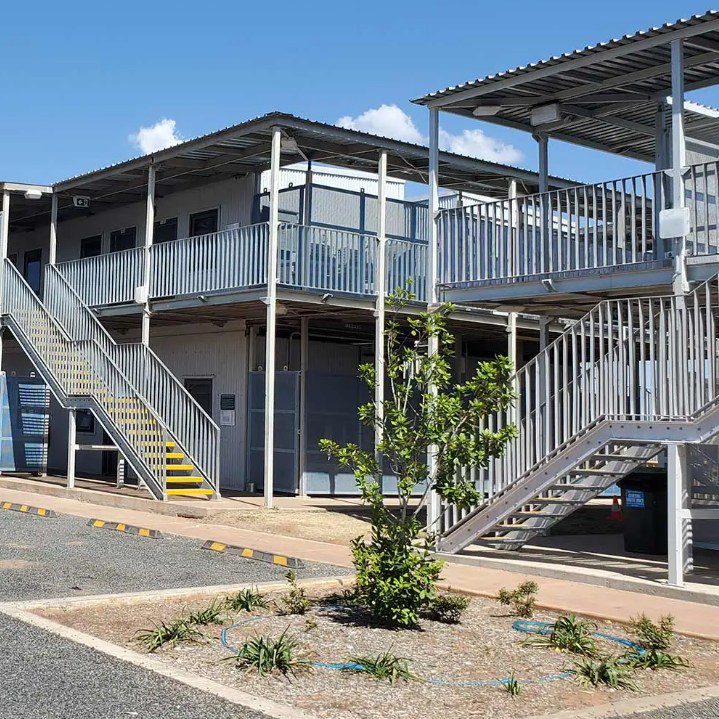
Rio Tinto’s A$100 million commitment to essential worker housing in the Pilbara, announced on 28 April 2026 as part of the company’s Seven Cities vision for regional Western Australia, is one of the deepest single signals in the Australian modular workforce-accommodation market this cycle. The funding supports the Western Australian Government’s build of more than 500 homes for regional frontline workers, delivered across the heartland of Rio Tinto’s Pilbara operations at Wickham, Tom Price, Paraburdoo and Roebourne, with additional Government Regional Officer Housing (GROH) stock flowing to Karratha. The State leads construction and holds delivery to GROH needs through to 2030, with the mining sector co-contributing a combined commitment reported at around A$170 million alongside the State’s own GROH funding.
If you are a head contractor, developer or delivery partner bidding into this pipeline, the read-through is simple: sustained, government-led demand for accommodation-grade modular product in a cyclonic region, on a multi-year horizon. This post walks through the delivery economics site by site, the compliance that a Pilbara camp actually has to carry, and where a modular systems supplier plugs into your scope.
The pipeline in one paragraph
The Seven Cities program is a State-led regional housing build, backed by mining-sector co-contribution, targeting frontline and essential-service workers rather than direct FIFO mining rosters. Rio Tinto’s A$100 million sits inside a larger combined mining commitment, and it stacks on top of expanded GROH funding in the WA 2026-27 State Budget. For builders, the important structural feature is that government leads the delivery and holds the head-contract relationship to 2030. That means repeatable, standards-driven procurement rather than one-off private camps, and it rewards suppliers who can show compliance evidence up front rather than reconstruct it late.
100-bed camp economics
A 100-bed modular accommodation camp delivered into the Pilbara does not price like a metro build. Total delivered and installed cost in a cyclonic wind region typically lands well above the mid-spec supply band once you add engineered tie-down, remote transport corridors and site establishment. As a market reference, fully installed regional camp cost commonly sits in the A$3,200 to A$4,800 per square metre range depending on specification, cyclone rating and remoteness. That figure is the total delivered number a head contractor carries, not a supply price.
EcoPrestige’s own contribution to that number is the module supply, which for accommodation-grade product is quoted from around A$2,300 per square metre ex-GST including ocean freight. The gap between the supply figure and the delivered figure is the builder’s site scope, cranage, cyclonic engineering and connections. Keeping those two numbers separate is the single most useful thing a bidder can do when modelling a Pilbara camp, because it stops a supply saving being mistaken for a delivered saving and protects the margin in the parts of scope the builder actually controls.
Programme advantage
The reason modular wins in the Pilbara is time, not headline price. Factory production runs in parallel with the builder’s civil and services works on site, which compresses the critical path. Against a conventional site-build, a modular accommodation program typically saves in the order of four to seven months, and EcoPrestige quotes an indicative programme saving of around 30 per cent on delivery time for suitable accommodation typologies. For a GROH-funded delivery or a mining operator staffing a shift roster, that compression is the difference between meeting a labour-intake window and carrying an empty roster.
Cyclonic compliance is the gate
The Pilbara sits in a cyclonic wind region under AS/NZS 1170.2, so tie-down and structural engineering are not optional line items, they are the qualification gate. EcoPrestige modules are built on a heavy-duty structural steel frame, engineered to the applicable cyclonic wind region and rated for the site, and every module is fabricated offshore under Australian engineering, Australian QA and Australian NCC compliance oversight before it ships. Workforce accommodation is typically certified to NCC Class 3 for shared residential accommodation, or Class 1a for standalone dwellings, with an Occupancy Certificate provided at handover. That compliance package, backed by a structural warranty and a 12-month materials and fitout warranty, is what lets a head contractor carry a government-standard camp through certification without gaps.
Where EcoPrestige plugs in
EcoPrestige supplies the structural modules: the steel frame, external cladding, windows and glazed doors, full internal fitout, hybrid flooring, lighting and power, and pre-installed split air conditioning, together with shop drawings, NCC documentation and building-permit support, plus the structural warranty and Occupancy Certificate at handover. The builder holds the head contract and the site: pad and footing systems engineered for cyclonic tie-down, civil works, service risers and mains connections, cranage and bolt-down install, site management and OH&S. EcoPrestige coordinates the install interface but does not carry install responsibility. That clean split is what makes a Pilbara camp easy to tender, easy to programme and easy to finance, because the factory-controlled scope is fixed-price before production and the builder keeps control of the site.
For the underlying cost logic, see our modular construction cost guide and the delivery timeline guide. For the compliance pack a certifier will ask for, see Evidence of Suitability. Builders working the region can also review our WA Pilbara worker accommodation and Rio Tinto channel-partner supply pages, or the overall modular for builders overview.
What bidders should do this quarter
Three moves put a head contractor in front of this pipeline. First, model supply and delivered cost as two separate numbers, so a factory saving is never confused with a site saving and the cyclonic engineering scope is priced honestly. Second, line up the compliance evidence early, because government-led GROH procurement rewards bidders who can show NCC Class 3 documentation, cyclonic engineering certificates and an Occupancy Certificate pathway at tender rather than after award. Third, lock a module supply partner who fixes price before production, so the factory-controlled portion of the camp carries no weather, trades or material escalation once the roster window is set. Sustained demand to 2030 favours the bidders who are compliance-ready now.
Frequently asked questions
How big is the Rio Tinto Pilbara housing commitment?
Rio Tinto committed A$100 million on 28 April 2026 to support the Western Australian Government’s build of more than 500 homes for regional frontline workers, as part of the Seven Cities vision, with mining-sector co-contribution reported at a combined figure of around A$170 million.
Which towns does the funding cover?
New homes are being delivered across Wickham, Tom Price, Paraburdoo and Roebourne in the Pilbara, with additional GROH stock flowing to Karratha. The State Government leads construction and holds delivery to GROH needs through to 2030.
What does a 100-bed Pilbara modular camp cost?
Total delivered and installed cost in a cyclonic region commonly sits in the A$3,200 to A$4,800 per square metre range depending on specification and remoteness. EcoPrestige’s module supply for accommodation-grade product is quoted from around A$2,300 per square metre ex-GST including ocean freight, with the balance being the builder’s site scope, cranage and cyclonic engineering.
How much faster is modular than a site build here?
Factory production runs in parallel with site civil works, which typically saves four to seven months against a conventional build, an indicative programme saving of around 30 per cent on delivery time for suitable accommodation typologies.
How are the modules engineered for cyclones?
The Pilbara sits in a cyclonic wind region under AS/NZS 1170.2. EcoPrestige modules use a heavy-duty structural steel frame engineered to the applicable cyclonic wind region and rated for the site, fabricated offshore under Australian engineering, Australian QA and Australian NCC compliance oversight.
What does EcoPrestige supply versus the builder?
EcoPrestige supplies the structural modules, fitout, compliance documentation, structural warranty and Occupancy Certificate. The builder holds the head contract and the site scope: footings and tie-down, civil works, service connections, cranage, bolt-down install and site management. EcoPrestige coordinates the install interface but does not carry install responsibility.
Get the EcoPrestige Builder Pack
Commercial price and supply guide plus the developer and builder scope overview. The two documents builders, developers and project managers ask for first. Instant access.
Prefer to talk direct? Email info@ecoprestige.com.au.