
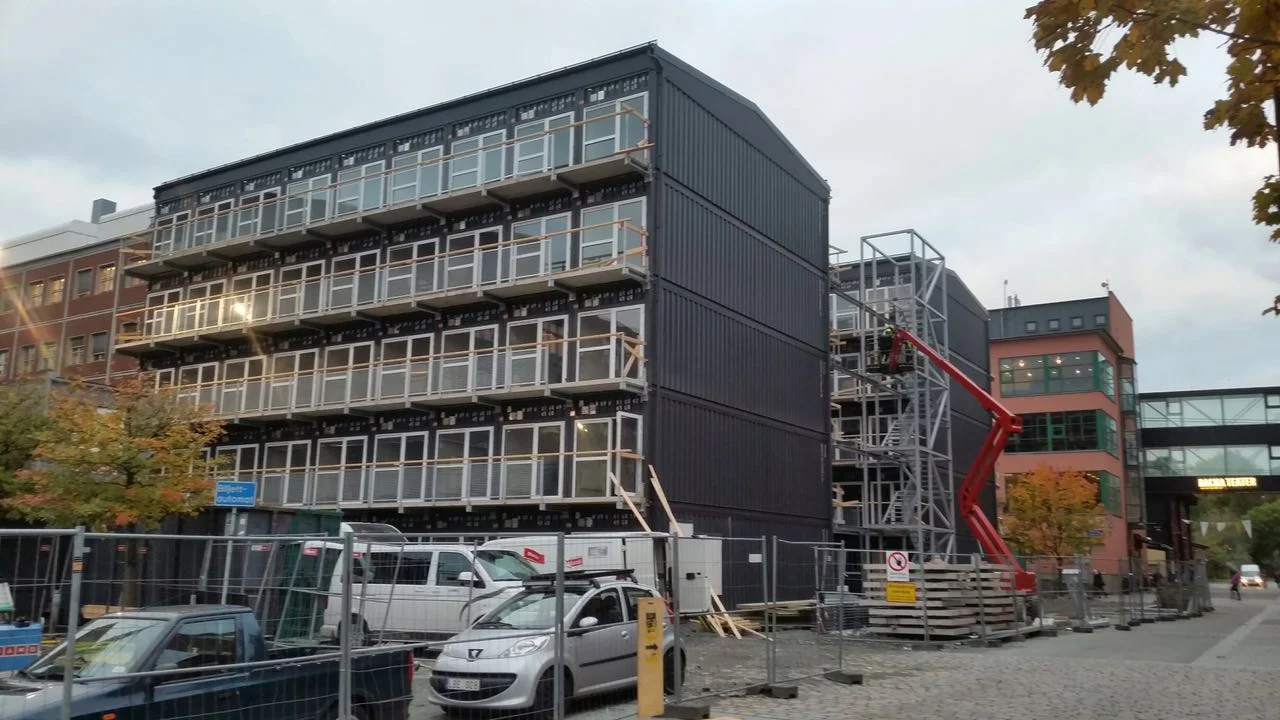
The Victorian School Building Authority (VSBA) Permanent Modular Building Program (PMBP) panel registration closes in 21 days. For modular suppliers and head contractors active in Victorian school construction, this isn’t a procurement formality — it’s the pre-qualification that determines which firms get shortlisted for the next five-year cycle of state-funded school capacity expansion.
This guide breaks down what the VSBA PMBP application actually tests, why generic responses get filtered out, and how to position your application against the assessment criteria.
What the VSBA PMBP Panel Actually Is
The VSBA Permanent Modular Building Program is the procurement framework Victorian government schools use when capacity expansion needs to be delivered on accelerated timelines — typically Term 1 / Term 3 lock-in dates that don’t accommodate traditional 14-22 month build programmes.
Panel membership covers modular classroom blocks, STEM facilities, multi-purpose halls, administration buildings, and prefabricated learning environments. The current cycle runs through 2026-2031 and represents the procurement gate for a state-funded capital programme estimated at $500 million across the period.
The Three Assessment Filters That Actually Matter
1. Off-Site Quality Assurance Evidence
VSBA assessors are not looking for generic ISO 9001 certificates. They are looking for module-level Non-Conformance Report (NCR) records, factory inspection reports tied to specific modules with serial numbers, and Quality Inspection Test Plans (ITPs) demonstrating hold points at structural framing, services rough-in, internal finish, and pre-shipping verification stages.
Applications that submit corporate QA policies without project-specific NCR examples are filtered at first-pass. Applications that submit module-traceable QA artefacts move to technical evaluation.
2. Producer Statement Chain Integrity
NCC 2022 Volume 1 Class 9b learning environments require a defensible producer statement chain. For modular delivery, that means:
- PS1 equivalent — structural design certification from the registered structural engineer, signed off against AS 1170 design actions and AS 3600 / AS 4100 detailing
- PS3 equivalent — off-site manufacture verification, certifying that the structural design has been built as drawn in the factory environment
- PS4 equivalent — on-site verification, certifying installation, inter-module connection, and services interface have been executed to design
Applications that demonstrate this chain with named engineers, signed certificates, and explicit reference to NCC compliance pathways win technical points. Applications that hand-wave with “we are NCC compliant” lose them.
3. Delivered Cost Certainty at Line-Item Level
VSBA reviewers benchmark applications against a known cost band: $310,000-$420,000 per 72m² metro classroom delivered turnkey. Pricing inside that band, with line-item breakdown across supply / freight / installation / commissioning / GST, signals operational maturity.
Pricing above the band requires explicit justification (e.g., regional logistics, cyclonic detailing, energy-rating upgrade above NCC minimum). Pricing below the band raises red flags about specification compliance and is usually scrutinised.
The 18-20 Week Programme Reviewers Verify
VSBA panel applications must commit to a delivery programme. The credible benchmark for a 4-classroom block is:
- Weeks 1-4: Design lock, structural certification, services coordination, council DA / Building Permit
- Weeks 5-12: Factory manufacture (parallel with site preparation: footings, services trenching, perimeter compliance)
- Weeks 13-15: Freight and site delivery (depending on factory location — China-based supply adds 2-3 weeks sea freight + 1 week MPI / Australian Border Force clearance)
- Weeks 16-19: Crane lift, inter-module connection, services commissioning, internal finish reinstatement
- Week 20: Practical completion, defects walk, occupation certificate
Programmes claiming 12-week delivery without addressing the parallel-processing logic get marked down. Programmes claiming 28-week delivery look uncompetitive against panel norms.
NCC Class 9b Compliance Stack
School modular construction in Victoria sits under NCC 2022 Class 9b. The compliance stack reviewers test:
- Fire — Section C performance: external wall FRL based on horizontal protection / setback, internal sound and fire separation, exit travel distances per Part D2
- Structural — AS 1170.0/1/2/4 for dead, live, wind, and seismic actions; specific attention to Victoria’s wind region A2-A3 and seismic kp 0.08-0.09
- Access — AS 1428.1 dimensional requirements for ramps, doorways, sanitary facilities; D2D2 wheelchair-accessible classroom standards
- Energy — Section J energy efficiency provisions for NCC 2022, including façade U-values, glazing SHGC, mechanical efficiency, and (new for 2022) condensation management
- Acoustics — Department of Education acoustic standards for learning environments: classroom-to-classroom STC, classroom-to-corridor IIC, HVAC noise NC ratings
Five Funding Streams Backing the Demand
Applications that demonstrate awareness of the funding context score higher than applications that treat VSBA procurement as standalone:
- VSBA capital expenditure — direct state appropriation, the primary funding source for permanent infrastructure
- Building Blocks Co-location Grants — when modular classrooms are co-located with kindergarten / early learning facilities
- Inclusive Schools Fund — when modular delivery supports students with disabilities or accessibility requirements
- Council co-contributions — particularly in growth-corridor LGAs (Wyndham, Casey, Hume, Whittlesea, Melton) where rapid enrolment growth outpaces state programming
- Federal STEM infrastructure — Commonwealth co-funding for science / technology / engineering / maths learning spaces
Common Application Mistakes
- Generic capability statement — failing to map specific past projects to VSBA-equivalent typology / scale / programme
- Missing producer statement chain — submitting QA policies instead of named-engineer certifications
- Cost padding — pricing above benchmark without justification; or pricing below without specification clarity
- Single-source crane assumption — failing to nominate craneage subcontractor and verify lift plan against typical school site constraints
- Acoustic non-engagement — assuming standard residential STC ratings carry over to NCC 9b learning environments (they don’t)
What EcoPrestige Provides for VSBA-Aligned Builders
EcoPrestige supplies structural steel modular systems through a builder-facing model. We do not contract directly with the VSBA. Our role in a head-contractor application is:
- Module-level NCR records and ITP artefacts that satisfy VSBA QA evidence requirements
- Producer statement chain coordination with the head contractor’s structural engineer and BCA / Surveyor
- Line-item pricing within VSBA benchmark band, with explicit breakdown supporting head-contractor tender submission
- 18-20 week programme with parallel-processing factory / site coordination
- NCC 2022 Class 9b compliance documentation pre-built for tender attachment
FAQ
How does the VSBA Permanent Modular Building Program work?
The VSBA PMBP is a panel-based pre-qualification framework for modular suppliers and head contractors delivering permanent modular school infrastructure in Victoria. Members of the panel are eligible to tender on individual VSBA modular projects across the panel cycle (currently 2026-2031). Panel registration runs in cycles; the current registration closes in approximately three weeks.
What does a modular classroom cost under VSBA procurement?
VSBA reviewers benchmark turnkey delivered cost at $310,000-$420,000 per 72m² metro classroom. Regional or specialist (STEM, accessibility) typologies sit higher. Cost certainty at line-item level is one of the three primary evaluation filters.
What is the VSBA delivery programme expectation?
The credible delivery programme for a 4-classroom modular block is 18-20 weeks from design lock to practical completion. This relies on parallel processing of factory manufacture with site preparation, and assumes timely design lock-in and council approvals.
What NCC compliance applies to VSBA modular classrooms?
NCC 2022 Volume 1 Class 9b. The compliance stack covers Section C fire, AS 1170 structural, AS 1428.1 access, Section J energy, and Department of Education acoustic standards for learning environments.
Can EcoPrestige apply to the VSBA panel directly?
EcoPrestige supplies through builder-facing partnerships, not as the head contractor of record on VSBA projects. Builders applying to the panel can use EcoPrestige’s QA documentation, producer statement chain coordination, and line-item pricing as part of their tender submission.
Next Steps for VSBA Panel Applicants
If you’re a Victorian-licensed head contractor preparing a VSBA panel application and need:
- A credible modular systems supplier with the documentation stack already built
- Module-level QA evidence aligned to the panel evaluation criteria
- Line-item delivered pricing for tender attachment
The application window closes in approximately three weeks. For a confidential discussion about partnership on your VSBA panel application, see our technical brochures or contact us.