
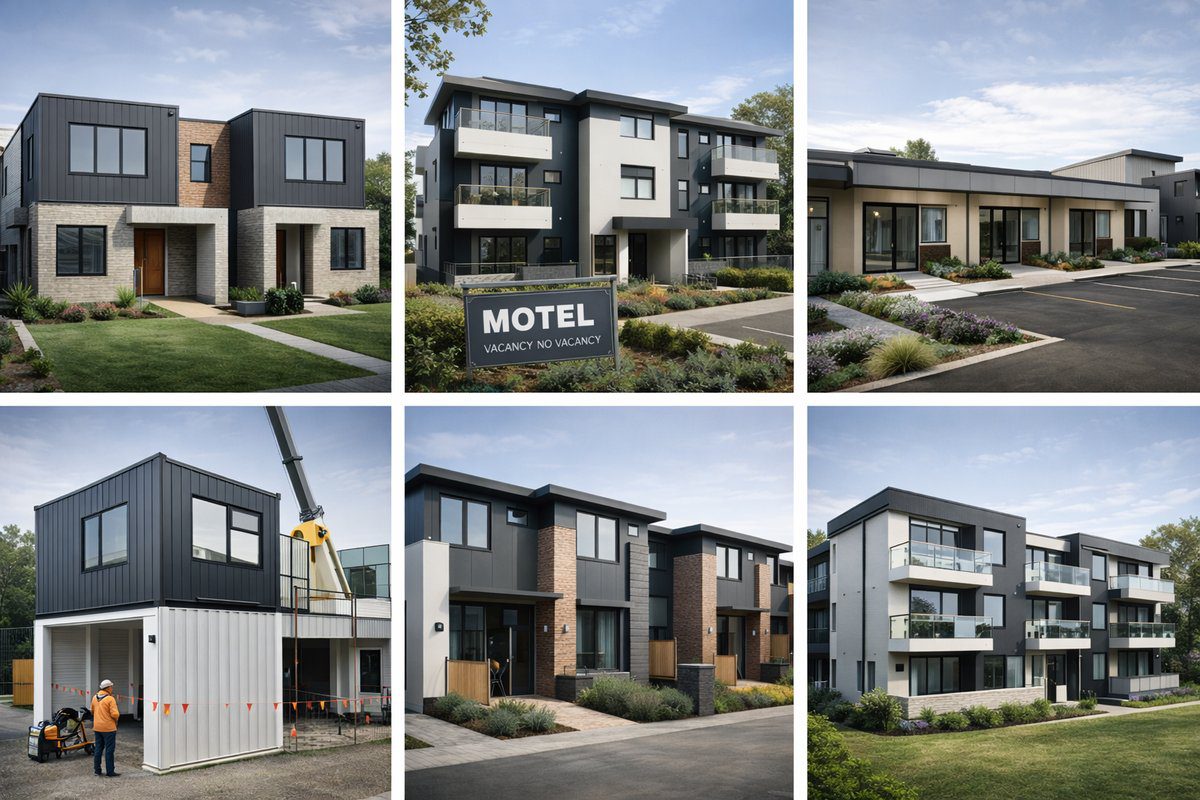
Wellington is the most seismically demanding capital in Australasia. The Region X seismic hazard factor of Z = 0.40 under NZS 1170.5 is the highest in New Zealand — more than three times Auckland (Z = 0.13) and one-third higher than Christchurch (Z = 0.30). For Wellington-area builders pricing modular workforce, education, healthcare or housing projects in 2026, that single number drives engineering, procurement and producer-statement strategy harder than in any other NZ market. Get the seismic and producer-statement chain right, and modular delivers a 6-9 month programme advantage and NZ$1.5-2.5M cost saving on a typical 24-unit social housing build versus traditional construction.
This guide is written for Wellington-region head contractors, developers and architects working with Kāinga Ora Wellington Regional, Te Whatu Ora Capital, Coast and Hutt Valley, Government Property Group (GPG), Wellington City Council, Hutt City Council, Porirua City Council, Upper Hutt City Council and Kāpiti Coast District Council. It covers the NZ$ supply benchmarks, NZBC producer-statement chain, CentrePort and Cook Strait logistics, BCA acceptance pathway, and a worked example for a 24-unit four-storey social housing build in Wellington.
How much does modular construction cost in Wellington?
Wellington supply benchmarks sit slightly above Auckland and Christchurch because of the seismic premium, harder soil-class engineering on reclaimed CBD land and Mt Victoria slopes, and tighter crane-access constraints in steeply graded suburbs (Kelburn, Khandallah, Wadestown, Brooklyn, Roseneath). Indicative builder-supplied benchmarks for 2026:
- Single-storey 1-bed studio (modular volumetric, NZBC E2/AS1 compliant): NZ$2,800-$3,400/m² supply DAP CentrePort
- 1-bed social housing module (NZS 1170.5 Z=0.40 design, NZBC C/AS2): NZ$2,900-$3,800/m² supply
- 2-bed accessible (Lifemark 4-Star) module: NZ$2,700-$3,500/m² supply
- Education classroom (NZ MoE DQLS-aligned): NZ$2,800-$3,600/m² supply
- Primary care clinic (Te Whatu Ora-aligned, NZBC G fit-out): NZ$3,400-$4,400/m² supply
- Worker accommodation 1BR SPQ: NZ$2,400-$3,000/m² supply DAP CentrePort
Add NZ$280-$520/m² for foundation engineering on TC2/TC3 land class, and NZ$140-$240/m² for Wellington-specific seismic-restraint detailing on services pass-throughs. Crane mobilisation on a CBD or hill-suburb site typically adds NZ$45,000-$95,000 versus an open Hutt Valley flat site. Section 73 covenants and TA-specific stormwater requirements (Wellington Water) sit outside supply scope and are head-contractor responsibility.
How long does modular delivery take in Wellington?
Programme to practical completion from design lock for a 24-unit Wellington four-storey project:
- Stage 1 – Design freeze, NZS 1170.5 / NZS 3404 engineering and producer statement chain (PS1): 6-8 weeks
- Stage 2 – Module manufacture, factory QA witness points, NZBC compliance evidence pack: 12-16 weeks
- Stage 3 – Pre-shipment final QA, MPI biosecurity pre-clearance, NZTA oversize permit lodgement: 2-3 weeks
- Stage 4 – Sea freight to CentrePort Wellington (port-of-discharge selection covered below): 14-21 days
- Stage 5 – Discharge, MPI inspection, lay-down, road transport with NZTA Class 1 / Class 2 permits, set-down with crane: 1-2 weeks
- Stage 6 – Module connection, services tie-in, BCA inspections, PS3 / PS4 sign-off, CCC application: 6-10 weeks
Total: 6-9 months from design lock to CCC application. Traditional masonry-and-block construction at the same density typically runs 14-22 months in Wellington, driven by trade-resource scarcity post-Naenae Pool and KiwiRail rebuild commitments, and weather sensitivity on hill sites. The modular programme advantage is largest on projects above six units; below that, traditional may match on smaller programme-management overhead.
NZBC compliance: producer statement chain (PS1, PS3, PS4)
Wellington City Council, Hutt City, Porirua, Upper Hutt and Kāpiti Coast BCAs require the same NZBC clauses as the rest of NZ but apply them under more rigorous seismic and wind-load review. The producer-statement chain that an EcoPrestige-supplied module ships with:
- PS1 – Design (Structural): Issued by an NZ-registered Chartered Professional Engineer (CPEng) using NZS 1170.5 (earthquake), NZS 1170.2 (wind, Region A2 with VR varying suburb-to-suburb), NZS 3404 (steel structures) and AS/NZS 4600 (cold-formed steel). Z = 0.40, soil class derived from site-specific geotech.
- PS1 – Design (Architectural and Fire): NZBC Clauses C/AS2 (fire), E2/AS1 (external moisture), G6 (airborne and impact sound), H1/AS1 (energy efficiency), F2 (hazardous building materials).
- PS3 – Construction Review (Off-site): Factory-stage QA witness points covering structural welding (AS/NZS 1554 Part 1 SP), waterproofing membranes, fire-rated linings, services rough-in, and final functional pre-shipment QA. Documented evidence pack travels with the module.
- PS4 – Construction Review (On-site): NZ-registered engineer reviews module-to-module connections, foundation tie-down, services commissioning, and seismic-restraint detailing on stair cores, lift shafts and rooftop plant.
BCA acceptance is an evidence-led process, not a “modular vs traditional” debate. WCC’s Building Compliance team and Hutt City’s BCA accept structural-steel volumetric modules routinely when the PS1/PS3/PS4 chain is complete and the head contractor (an NZ-registered Licensed Building Practitioner with the appropriate licence class) carries on-site construction responsibility. EcoPrestige supplies the modules and producer-statement evidence pack; we do not contract directly with KO, Te Whatu Ora or any council BCA.
CentrePort Wellington vs Tauranga vs Lyttelton: port-of-discharge logic
CentrePort Wellington is the natural port of discharge for projects in the Wellington region, but it is not always the optimal port. Operational considerations as of 2026:
- CentrePort Wellington: 14-18 day vessel transit from Chinese east-coast manufacturing, MPI clearance 1-3 days for steel-only modules. Direct rail and road links into Wellington, Hutt and Porirua. Heavy-lift container-vessel windows can be tighter than Auckland; book 6-8 weeks ahead. Best for Wellington City, Hutt, Porirua, Upper Hutt projects.
- Port of Tauranga: Higher container-vessel frequency, often shorter MPI hold. For Kāpiti Coast or Wairarapa projects with longer onward road transport, Tauranga can save 3-5 days at port at the cost of 5-7 hours on NZTA oversize-permit road haulage. Run the maths: vessel-window saving versus road-permit hours and crane-redeployment overhead.
- Lyttelton (South Island): Only used for Wellington if a single shipment is splitting Wellington and South Island delivery. Cook Strait inter-island transfer adds 1-2 days plus Interislander capacity windows, so this is a niche routing.
Wellington Regional Emergency Management Office (WREMO) requirements do not directly govern port-of-discharge selection but do shape laydown-yard and emergency egress planning around CentrePort — ask your head contractor’s logistics lead to confirm.
Seismic engineering: Wellington Z=0.40 vs Auckland Z=0.13 vs Christchurch Z=0.30
Wellington’s Z = 0.40 hazard factor under NZS 1170.5 has three direct supply-side implications:
- Heavier structural-steel chassis design: Module corner posts, perimeter beams and floor joists are sized 15-25% heavier than an equivalent Auckland module to handle base-shear and inter-storey drift on a four-storey build. This is a design-time cost, not a manufacturing risk.
- Inter-module connection detailing: Bolted bracket connections between stacked modules are designed for higher cyclic load and are reviewed at PS4 stage. Wellington-experienced PS4 engineers flag connection sequencing on the lift programme.
- Services pass-through restraint: Any service penetration between modules (water, waste, electrical, comms) requires a flexible coupling rated for 1.5x design drift. This is standard practice for any NZS 4219-compliant building services design and adds NZ$140-$240/m² to the supply package.
Importance Level (IL) 2 covers most Wellington residential and education builds. IL 3 applies to clinics, emergency services and schools serving as emergency shelters. IL 4 applies to hospitals and post-disaster facilities (rare for modular). The IL drives the return-period factor R applied to Z — IL 3 buildings see R = 1.3 vs IL 2 R = 1.0, increasing design loads accordingly. Flag IL early; it is the single biggest engineering-cost driver after Z.
Worked example: 24-unit four-storey KO Wellington Regional social housing
A Lower Hutt site, TC2 land class, IL 2, four-storey stacked modular, mix of 12 x 1-bed (45m²) and 12 x 2-bed (65m²) units. Total GFA approximately 1,320m².
- Modular supply (DAP CentrePort, including Wellington seismic detailing): NZ$3,750,000-$4,950,000
- Foundation, civils, head-contractor preliminaries, BCA fees: NZ$1,150,000-$1,650,000
- On-site set-down, services tie-in, landscaping, finishes: NZ$700,000-$950,000
- Total turnkey range: NZ$5.6M-$7.55M
- Equivalent traditional masonry-and-block build (24 units, four-storey, Wellington): NZ$7.6M-$10.0M, 18-24 month programme
- Saving: NZ$1.5M-$2.5M, 8-15 months earlier rent commencement
For Kāinga Ora Wellington Regional, the rent-commencement uplift alone (24 units x NZ$520/week average x 8-15 months earlier) is NZ$1.0M-$1.95M of additional rental income inside the development envelope.
Five common pitfalls Wellington-region builders should avoid
- 1. Designing to Auckland or Christchurch Z and re-rating later. Specify Z = 0.40 at design freeze. Retrofitting structural design after manufacture starts is expensive and breaks the producer-statement chain.
- 2. Underestimating geotech variability. Reclaimed CBD land (Thorndon, Pipitea), Hutt Valley alluvium, hill-suburb weathered greywacke and Kāpiti Coast dune sand each demand different foundation engineering. Pay for the site-specific geotech report before locking module dimensions.
- 3. Treating CentrePort as default without checking vessel windows. If your manufacturing slot lands in a CentrePort vessel-window gap, Tauranga can save weeks. Run the comparison.
- 4. Booking crane mobilisation late. Wellington’s heavy-lift crane fleet is small. Book 8-10 weeks ahead, especially for hill-suburb and CBD sites where reach and slew radius matter.
- 5. Skipping the IL 3 test for clinics and education buildings. Te Whatu Ora primary-care builds and many education facilities are IL 3, not IL 2. The R = 1.3 uplift drives 12-18% additional structural-steel cost. Confirm IL with the design lead at PS1 stage.
Frequently asked questions
How much does modular construction cost in Wellington in 2026?
Indicative supply benchmarks DAP CentrePort: NZ$2,400-$3,000/m² for 1BR worker SPQ, NZ$2,900-$3,800/m² for 1BR social housing, NZ$2,800-$3,600/m² for MoE DQLS-aligned classrooms, and NZ$3,400-$4,400/m² for primary-care clinics. A 24-unit four-storey Lower Hutt social housing project lands at NZ$5.6M-$7.55M turnkey vs NZ$7.6M-$10.0M traditional.
How long does a modular project take in Wellington?
Six to nine months from design lock to CCC application for a 24-unit four-storey build, versus 14-22 months for equivalent traditional construction. Modular’s programme advantage is largest above six units. The biggest single risk to programme is foundation engineering on site-specific geotech — lock geotech before module dimensions.
Will Wellington City Council, Hutt City and Porirua BCAs accept modular construction?
Yes, when the PS1/PS3/PS4 producer-statement chain is complete and the head contractor is an NZ-registered LBP carrying on-site construction responsibility. WCC and Hutt City BCAs accept structural-steel volumetric modules routinely. The acceptance bar is evidence-led, not a debate about modular versus traditional.
What seismic standard applies to modular buildings in Wellington?
NZS 1170.5 with Z = 0.40 (Region X), the highest hazard factor in New Zealand. Importance Level 2 covers most residential and education builds; IL 3 applies to clinics and schools used as emergency shelters and adds R = 1.3 (12-18% structural-steel cost uplift). NZS 3404 (steel) and AS/NZS 4600 (cold-formed steel) govern member design.
Can Kāinga Ora Wellington Regional, Te Whatu Ora and GPG procure modular directly from EcoPrestige?
EcoPrestige supplies modules and the producer-statement evidence pack to NZ-registered LBP head contractors who hold the head-contract with KO, Te Whatu Ora Capital, Coast and Hutt Valley, GPG, or the relevant council. We do not contract directly with the agency or BCA. This builder-facing supply model keeps the construction-licence and BCA-accountability stack clean for Wellington-region delivery.
Next step
Wellington-region head contractors and developers pricing modular workforce, education, healthcare, social-housing or accommodation projects can request the EcoPrestige technical brochure pack covering structural-steel module specifications, NZ producer-statement chain documentation, and reference projects. For Wellington-specific scope queries, BCA-acceptance evidence packs, or builder-supply commercial discussions, contact our Wellington-region builder team.
Related EcoPrestige resources: Modular Construction NZ: Complete Guide for Builders & Developers 2026 · Modular Construction Auckland 2026 · Modular Construction Christchurch 2026 · NZ Procurement Pathways for Australian Builders · Procurement Guide WA, NT, TAS & NZ · Modular Classrooms New Zealand — MoE DQLS · Modular Healthcare Buildings New Zealand · Modular Aged Care Buildings New Zealand · Evidence of Suitability — AU NCC Compliance Guide · Modular Construction Timeline Guide