
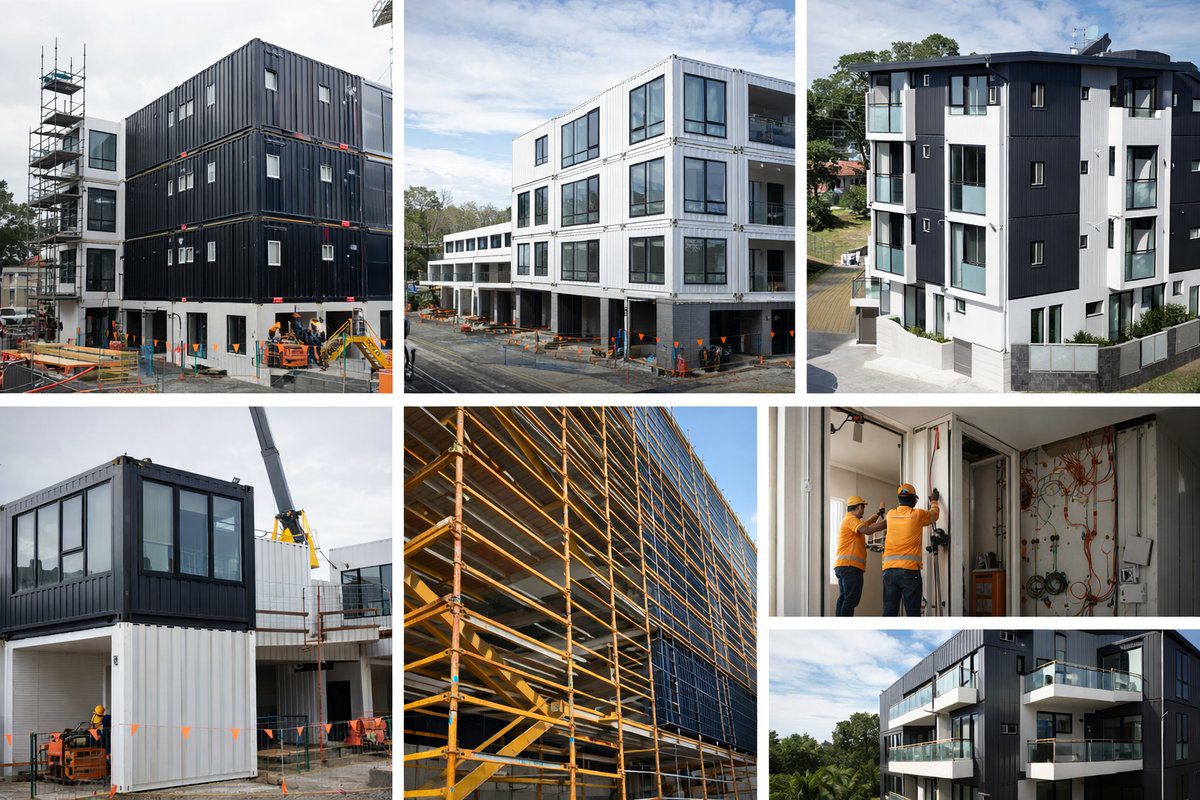
The New Zealand School Property Agency (NZSPA) has announced an H2 2026 offsite-manufacturing (OSM) mandate for school capacity expansion projects. The mandate is structural — not pilot, not preference — and represents the largest single buyer-creation event in the New Zealand modular construction market in the last decade. For NZ Licensed Building Practitioners, head contractors, and modular suppliers serving the school sector, the policy shift fundamentally changes which firms can compete for state-school work from late 2026 forward.
This guide unpacks the NZSPA OSM mandate, the practical compliance shift for head contractors, and what the policy signals about the next 5 years of NZ school capital procurement.
What NZSPA announced
The NZSPA (the school-property arm of the New Zealand Ministry of Education) confirmed that from H2 2026, school capacity expansion projects will default to offsite-manufactured (OSM) delivery, with traditional in-situ construction permitted only where an OSM solution is not feasible or not cost-competitive. Key structural terms of the announcement:
- Scope: Capacity expansion projects (new classroom blocks, kindergarten additions, library and learning-support spaces).
- Trigger date: H2 2026 financial-year commencement.
- Coverage: National — all NZ school property authorities, not just MoE-direct projects.
- Carve-out: Heritage-protected schools and small-island schools (logistically infeasible).
- Procurement vehicle: Existing NZ MoE OSM Panel + project-specific RFP for non-panel work.
Why the OSM mandate matters more than the OSM Panel
The NZ MoE has operated an Offsite Manufacturing Panel for several years. The Panel established the supplier roster and procurement mechanics for modular school delivery. The H2 2026 mandate is a different category of policy decision — it is a demand-side commitment. The OSM Panel told the supply side “we want you here.” The OSM mandate tells the buyer side “this is the default delivery method.”
For head contractors, the practical consequence is that traditional-build bids on capacity-expansion projects now need positive justification, not implicit acceptance. The default has shifted.
Three things NZ head contractors should be doing in the next 90 days
1. Confirm OSM Panel alignment or non-panel positioning
The OSM Panel covers the bulk of capacity expansion work, but project-specific RFPs still operate where Panel coverage is incomplete. Head contractors need to know which lane they sit in for each region they pursue.
2. Audit Producer Statement chain capacity
OSM-delivered school buildings still satisfy NZS 1170 series structural requirements, NZBC clause B1 structural integrity, and the PS1 / PS3 / PS4 producer-statement chain. For head contractors who have historically relied on in-situ engineers, the shift to OSM requires PS1 / PS3 from the modular manufacturer’s engineering team and PS4 from the head contractor’s site engineer. This stack needs to be inventoried before the first H2 2026 tender lands.
3. Confirm modular supply partnerships ahead of demand spike
The NZSPA mandate will pull demand toward a limited number of OSM-capable suppliers. Head contractors without a confirmed modular supply partnership before mid-2026 will face supply-side rationing through 2027 — the same pattern that played out in NSW after the 2019 modular schools policy shift.
Where this connects to the NZ school capacity demand picture
The OSM mandate sits on top of an already-documented demand pipeline. The NZ MoE OSM Panel work in Taranaki, Hawke’s Bay, and Otago represents the geographic concentration of current demand — the H2 2026 mandate broadens this to the full national pipeline.
For Auckland-based head contractors specifically, the existing Auckland modular construction cost, compliance and delivery guide covers the North Island procurement and compliance context that applies to OSM-mandated school work from H2 2026.
EcoPrestige’s position
EcoPrestige operates as a builder-facing modular supplier with NZS 1170 structural compliance, PS1 / PS3 producer-statement capability through a registered NZ engineering chain, NZ$2,400 – $4,200/m² supply range, and 6-9 month delivery windows for classroom-block configurations. We do not pursue head-contractor work in New Zealand — we strengthen the OSM-mandate response of NZ-LBP head contractors who do.
For NZ head contractors positioning for H2 2026 OSM-mandate work and looking for a credible modular supply partner with the producer-statement chain already in place — DM open.
Frequently asked questions
NZSPA confirmed that offsite manufacturing (OSM) becomes the default delivery method for New Zealand school capacity expansion from the second half of 2026, shifting standard classroom and block delivery toward modular.
The Panel sets who can be engaged; the mandate sets how schools will be built by default. The mandate creates structural demand for modular supply regardless of panel membership, reshaping the NZ school delivery market.
Confirm OSM Panel alignment or non-panel positioning, audit producer statement chain capacity, and lock in modular supply partnerships ahead of the demand spike.
A producer statement chain (PS1 design, PS3 construction/off-site, PS4 on-site review) plus NZBC compliance and NZS 1170.5 seismic design appropriate to the region.
EcoPrestige supplies structural-steel modules with Australian engineering and QA oversight and producer-statement-aligned documentation an NZ-LBP head contractor needs. EcoPrestige supplies into the head contractor’s scope and does not contract with the agency directly.
Get the EcoPrestige Builder Pack
Commercial price and supply guide plus the developer and builder scope overview. The two documents builders, developers and project managers ask for first. Instant access.
Prefer to talk direct? Email info@ecoprestige.com.au.