
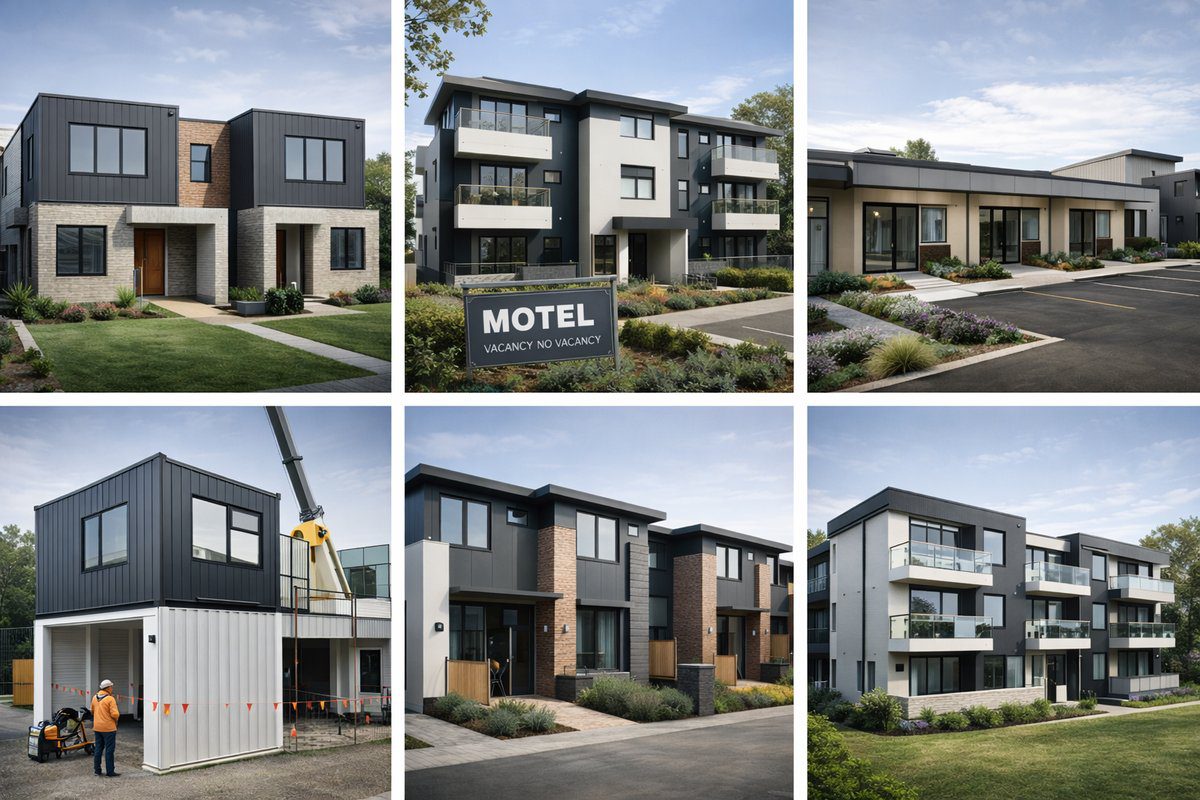
The South Australian modular pipeline finally has the funding behind it to match the demand. Between SA Housing Authority’s rolling social housing builds, the Department for Education’s regional classroom upgrades, Mount Gambier and Whyalla Hospital expansions, and the workforce housing surge tied to Whyalla’s green steel transition and Port Augusta’s renewable corridor, SA builders are quoting more modular packages in 2026 than at any point in the last decade.
This guide is for SA-based builders, developers and head contractors who need clean numbers — supply benchmarks, programme durations, compliance pathways, port logistics, and the five mistakes that turn good modular projects into disputes.
What SA Builders Pay: 2026 Supply Benchmarks by Sector
Indicative 2026 supply rates, ex-factory, DAP a nominated SA address, structural steel modular system:
- Childcare / ELC (NCC Class 9b): $2,800–$3,900/m²
- Classroom modular (DfE-spec): $2,400–$3,400/m²
- Social housing 1BR/2BR ILU (Class 1a): $2,300–$3,100/m²
- Workforce SPQ accommodation (Class 1b): $2,500–$3,400/m²
- 3BR family dwelling (Class 1a): $2,200–$2,900/m²
- Healthcare clinic / consult suite (Class 9a): $3,200–$4,500/m²
These rates assume base-spec finishes, Adelaide-zone wind loading (AS 1170.2 Region A, V_R = 41 m/s), and a 6–8 module job. Uplift detailing for Far North SA (Coober Pedy, Marla, Oodnadatta corridor) typically adds 6–12% to the chassis line. See our modular construction costs guide for national pricing context.
Compared to traditional construction at $3,600–$5,800/m² delivered Adelaide metro (2026 SA MBA/HIA benchmarks), modular supply runs 18–28% cheaper on direct cost and removes 9–16 weeks of programme. On social housing IRRs, the financing-cost saving is often larger than the build-cost saving.
SA Compliance Stack: NCC + Ministerial Specification SA G5
Three layers SA builders must verify on every modular package:
- NCC 2022 Volume 1 or 2 by use class — same as every other Australian jurisdiction.
- Ministerial Specification SA G5 — South Australia’s variation governing relocatable and transportable buildings. SA G5 reads onto NCC Section J energy efficiency, AS 4100 steel framing, and AS 3959 BAL ratings for sites inside the SA Country Fire Service interface mapping.
- Evidence of Suitability — Schedule 5 of the SA Development Regulations requires performance-based evidence chains for off-site manufactured elements. Engineering certification, factory QA records and module connection details must be lodged with the private certifier or council before Class 1 Building Consent issues.
Builders new to SA modular often miss step 3 and surface compliance gaps weeks before delivery. Our Evidence of Suitability guide sets out the exact document chain SA private certifiers expect.
Seismic note: Adelaide sits in AS 1170.4 hazard zone with kp ≈ 0.10–0.11 — lower than Christchurch’s 0.30 but higher than most inland NSW. Two-storey stacked modules in Adelaide CBD require diaphragm-action verification, not just gravity tie-downs.
Logistics: Outer Harbor, Port Pirie and Regional Routes
For containerised or barge-delivered modules, the realistic SA port options are:
- Outer Harbor / Port Adelaide: primary container terminal, MSC and ANL weekly vessel calls from Asian fabrication hubs. 14–21 day vessel time from Xiamen/Shanghai, 1–2 day clearance, 50–120 km surface lift to most metro Adelaide sites.
- Port Pirie: serves Upper Spencer Gulf and Far North SA — Whyalla, Port Augusta, Roxby Downs. Removes oversize-permit kilometres versus trucking from Adelaide.
- Port Lincoln: Eyre Peninsula route for Streaky Bay, Ceduna and remote west-coast deliveries.
SA Department for Infrastructure and Transport issues Class 1 oversize permits via the National Heavy Vehicle Regulator portal; pilot vehicle requirements trigger at 3.5 m width and night-curfew restrictions apply to all CBD lifts. Crane day must align with Adelaide City Council’s 7am–7pm weekday noise window.
Six SA Demand Drivers Building the 2026 Pipeline
- SA Housing Authority / Renewal SA — ~2,400 new public dwellings funded under the National Housing Accord through 2029.
- Department for Education capital works — Term-3 and Term-1 classroom replacements across Murraylands, Riverland and Limestone Coast.
- Whyalla green steel transition — GFG Alliance and SA Government workforce accommodation tied to hydrogen-DRI commissioning.
- Mount Gambier and Whyalla Hospital expansion — SA Health off-site consult suite and ward extension packages.
- Federal Building Early Education programme — uncontested regional ELC supply opportunity in Mid North and Yorke Peninsula.
- Port Augusta and Port Pirie renewable hubs — Solar Reserve, Aquila and BlueScope-adjacent workforce demand.
Volume here favours SA builders who pre-qualify for state procurement panels and can quote off-site solutions directly into Renewal SA and DfE tenders. Our procurement pathways guide covers the panel structures most relevant to SA crossover bidders.
Five Pitfalls That Sink First-Time SA Modular Projects
- Treating SA G5 as identical to NCC — SA G5 has variations on services penetrations and bushfire interface that catch interstate builders mid-certification.
- Underestimating Outer Harbor lift-out windows — port handling slots fill 4–6 weeks ahead in Q4.
- Pricing Adelaide rates for Far North sites — Coober Pedy and APY Lands logistics add $180–$340/m² that interstate fabricators routinely forget.
- Skipping council pre-lodgement — Adelaide, Onkaparinga and Salisbury councils accept modular but require staged certifier conversations early.
- Single-source crane assumption — Adelaide has four reliable 200t+ crane operators; book by milestone, not by week.
For programme planning, our modular timeline guide breaks each phase from order through practical completion.
Next step for SA builders: Download the EcoPrestige capability statement for SA-specific module specifications, supply benchmarks and compliance evidence templates — or contact the commercial team for project-specific SA pricing.
Frequently Asked Questions
How much does modular construction cost per m² in South Australia in 2026?
Supply benchmarks for SA in 2026 range from $2,200/m² for 3BR family dwellings to $4,500/m² for healthcare consult suites, ex-factory DAP a nominated SA address. Sector bands: childcare $2,800–$3,900, classroom $2,400–$3,400, social housing $2,300–$3,100, workforce accommodation $2,500–$3,400.
What is the typical programme for a modular project in Adelaide?
A 6–8 module project from order to practical completion runs 5–8 months in SA, versus 14–22 months for an equivalent traditional build. Factory fabrication overlaps with site civils, removing 9–16 weeks of programme.
Which SA compliance standards apply to modular buildings?
NCC 2022, Ministerial Specification SA G5 (SA’s relocatable/transportable variation), and the Evidence of Suitability chain required under SA Development Regulations Schedule 5. Bushfire BAL ratings apply where SA CFS interface mapping triggers them.
Which Adelaide port handles oversize modular deliveries?
Outer Harbor (Port Adelaide) is the primary container terminal for metro deliveries. Port Pirie serves Upper Spencer Gulf and Far North SA; Port Lincoln serves Eyre Peninsula and remote west-coast deliveries. NHVR permits are required for all oversize loads.
Can SA Housing Authority and the Department for Education procure modular directly?
SA Housing Authority (Renewal SA) procures via head-contractor builders licensed in SA. DfE uses a mix of direct procurement and head-contractor panels for capital works. Modular suppliers typically engage as nominated subcontractors to SA-licensed head contractors.