
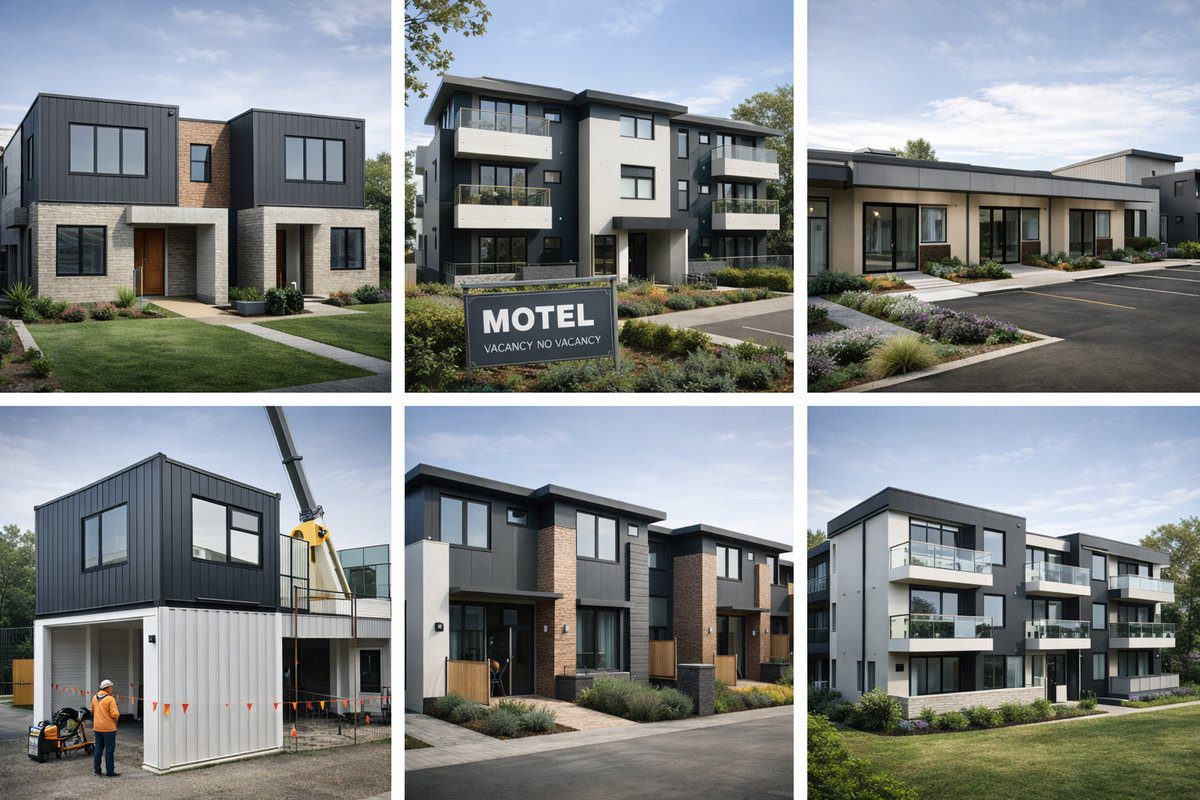
Auckland’s 2026 build pipeline is dominated by infrastructure programmes that reward speed: Kāinga Ora’s North Island delivery, Watercare’s site office and worker accommodation needs, the Ministry of Education’s Off-site Manufactured Building (OMB) Panel, and Auckland Council’s growing community asset programme across the isthmus, North Shore, Manukau and Franklin. For builders pricing these projects, the question is no longer whether modular fits — it is which procurement pathway, which compliance stack, and which delivery route protects programme.
As the manufacturer, EcoPrestige is responsible for every module: built and inspected in an offsite factory to Australian engineering and QA, then delivered to site. EcoPrestige supplies modular systems to NZ-licensed builders — we do not contract directly with end clients and we do not hold the LBP head-contractor obligation, so the structure below assumes a builder-led procurement model.
Auckland modular demand signals — what’s driving 2026 procurement
Three forces shape Auckland’s 2026 modular pipeline. First, Kāinga Ora’s North Island programme continues to push offsite manufactured housing into builder-led panel arrangements, including Mt Roskill, Manurewa and Northcote regeneration zones. Second, the Ministry of Education’s OMB Panel pre-qualifies suppliers for school classroom projects across Tāmaki Makaurau, with pricing that rewards repeatable typologies. Third, Watercare and Auckland Transport’s depot, site office and worker accommodation needs scale with the Central Interceptor and CRL precinct works.
Add Auckland Council’s community facilities programme — childcare centres, library extensions, sports pavilions — and the long-running shortage of NZ-registered LBP supervisors capable of pricing volumetric modular at scale, and the commercial argument for modular Auckland delivery is structural rather than cyclical.
Auckland modular cost benchmarks 2026 (NZ$, supply-only, ex-GST)
Supply price is quoted for your site. What moves the cost: the building class and how your building surveyor reads it; the site (slope, soil, access and crane position); wind region and bushfire rating, which are set per site; transport distance from the factory; services and fit-out level; and how early the design is locked. Site works, footings, services, freight, crane and installation are priced separately by the builder. Send the site and brief to prebuilt@ecoprestige.com.au for a written price.
The benchmarks below reflect supply-only delivered DAP a Tāmaki Makaurau yard or site, excluding NZ-side groundworks, services connections, council fees, and head-contract preliminaries. Onsite components are priced separately by the head contractor under the builder’s licence.
- Supply price is quoted for your site. Our published commercial rates are $2,200/m2 for childcare and school buildings, $2,300/m2 for apartments, motels, cabins and caravan parks, and $3,300/m2 for hotels, plus GST, and they apply only with a 2,400 mm ceiling and a site within 40km of the Melbourne port; any other project is requoted, never scaled
- Supply price is quoted for your site
- Supply price is quoted for your site
- Supply price is quoted for your site
- Supply price is quoted for your site
- Supply price is quoted for your site
Supply price is quoted for your site. The saving is not the headline rate — it is the programme compression that releases capital cycles 8–14 months earlier.
NZBC compliance — what the producer-statement chain looks like
. The PS1 must reference NZS 1170.0–.5 loadings, NZS 3404 for steelwork, and NZBC clauses B1, B2, C, D, E, F, G and H as relevant to the typology.
Auckland’s seismic environment is materially less demanding than Christchurch — the NZS 1170.5 hazard factor Z for central Auckland is approximately 0.13 versus 0.30 for Christchurch — which means lower module-to-foundation tie-down forces and more straightforward bracing, but the same documentation discipline. EcoPrestige issues this PS3 stack with every Auckland delivery — but the builder still needs an NZ-registered engineer engaged for the PS1 and PS4.
Port logistics — Ports of Auckland vs Tauranga
Ports of Auckland (Fergusson Container Terminal) is the closest discharge for CBD, North Shore, Mt Roskill and central isthmus sites — typical truck movement is under 25km.
1m. For Auckland CBD installs, the night-window crane lift restrictions imposed by Auckland Transport (typically 22:00–05:00 for road closures around tower cranes) need to be priced into the head contractor’s lift plan, not assumed.
Programme — 6–9 months delivered vs 14–22 months traditional
For a 24-unit Auckland modular building (typical KO-aligned brief, mixed 1BR/2BR), the programme breakdown looks like this:
- Design lock + PS1 + BCA consent: 8–12 weeks (parallel with site works planning)
- As the manufacturer, EcoPrestige is responsible for every module: built and inspected in an offsite factory to Australian engineering and QA, then delivered to site.
- As the manufacturer, EcoPrestige is responsible for every module: built and inspected in an offsite factory to Australian engineering and QA, then delivered to site.
- Site delivery + crane lift + module connection: 2–4 weeks
- Services commissioning + finishes + practical completion: 4–6 weeks
Total: 27–40 weeks (6–9 months) from design lock to handover. The same 24-unit brief built traditionally in Auckland typically programmes at 60–95 weeks (14–22 months) given current trade availability and weather risk. The delta is the commercial argument — capital is released 8–14 months earlier, and the head contractor’s preliminary cost burn is materially shorter.
Worked example — 24-unit Auckland social housing brief
Brief: 24-unit social/affordable housing, mixed 1BR (12 units, ~42m²) and 2BR (12 units, ~59m²), 2-storey, central Auckland infill site, KO-aligned brief, NZBC Class C apartment compliance, full LHA Silver accessibility, structural steel volumetric.
- Total GFA: ~1,212m²
- Programme: 7–9 months factory finished vs 16–20 months traditional
The 9–11 month programme advantage is what unlocks earlier rental or sale revenue and shortens construction-finance interest.
5 first-time Auckland modular pitfalls — what to avoid
- Pricing modular against light-frame portable benchmarks. Supply price is quoted for your site; comparing the two on rate gives you the wrong scope and the wrong supplier. Benchmark against permanent NZBC-compliant construction.
- Skipping the PS3 fabrication stack at consent stage.”post-consent attachment” creates 4–8 week delays at PCC.
- Locking the design before the engineer signs off module-to-foundation tie-downs. Auckland’s Z=0.13 is forgiving but TC2/TC3 land class around the isthmus (especially Mt Roskill and parts of South Auckland) still drives bracing and pile design. Resolve this at PS1 stage, not on site.
- Assuming Ports of Auckland night-curfew lifts apply to greenfield sites. They don’t — but the cost of a mid-project assumption flip (e.g. discovering you need a 220t crane instead of a 130t) lands on the head contractor, not the supplier. Lock the lift plan early.
- Underestimating MPI biosecurity hold times for timber-content modules. Steel-only modules typically clear in 1 day; modules with timber framing or untreated cladding components can hold 3–7 days. Build the buffer into the programme.
Auckland modular FAQ — for builders and developers
How much does modular construction cost in Auckland in 2026?
Supply price is quoted for your site. Onsite groundworks, services, council fees and head-contract margin are priced separately by the NZ-licensed builder.
How long does a 24-unit Auckland modular project take?
From design lock to handover, a 24-unit Auckland modular building typically programmes at 27–40 weeks (6–9 months). This compares to 60–95 weeks (14–22 months) for the same brief built traditionally.
Does Auckland Council accept factory-built modular?
As the manufacturer, EcoPrestige is responsible for every module: built and inspected in an offsite factory to Australian engineering and QA, then delivered to site..
Which port is preferred for Auckland modular delivery?
For CBD, North Shore and central isthmus sites, Ports of Auckland (Fergusson Container Terminal) is the closest discharge with under 25km truck movement.
Can EcoPrestige price directly against Kāinga Ora and MoE OMB Panel briefs?
EcoPrestige supplies modular systems to NZ-registered LBP head contractors and panel-listed builders — we do not contract directly with KO or MoE as principal. Builders pricing OMB Panel or KO North Island briefs can engage EcoPrestige as the modular supply partner, with the LBP head contractor holding the principal contract and the licence-supervised installation responsibility.
Next step for Auckland builders and developers
If you are pricing an Auckland brief — KO panel work, MoE OMB classroom, Watercare site office, Auckland Council ELC, or a private apartment / motel project — the fastest commercial answer is a feasibility check against your specific typology and site. Send the design brief, GFA estimate and target programme via the contact form below, and we will return cost benchmarks, programme indicative and a producer-statement scope split inside one working week. Brochures with structural specifications, NCC/NZBC compliance pathways and reference projects are linked below for technical due diligence.
Related guides: Modular Construction in New Zealand — Complete Guide for NZ Builders and Developers 2026 | Modular Construction Christchurch 2026 — Cost, Compliance and Delivery Guide | Modular Construction NZ in 2026 — Procurement Pathways for Australian Builders | Modular Construction Procurement Guide — WA, NT, TAS and NZ Government Projects 2026 | Modular Childcare Centres New Zealand | Auckland Modular Construction — Housing and Commercial Development | Evidence of Suitability — NCC Compliance Guide | How Long Does Modular Construction Take — Timeline Guide | Brochures (specs, pricing, reference projects) | Contact EcoPrestige
Auckland Modular Construction FAQ — NZBC, seismic, port logistics
Direct answers for builders, architects, and developers scoping modular delivery into Auckland and the wider North Island. All compliance references current to 2026 NZBC.
What NZBC documentation is required for factory-built modules in Auckland?
Building Consent Authority (BCA) sign-off must be on a pathway that already accommodates offsite manufacture.
What is the seismic Z-factor for Auckland modular projects?
Auckland sits at minimum Z=0.13 for seismic design. Modules supplied for Auckland must be engineered for Z=0.13 with appropriate ductility and detailing. Sites in the wider North Island lift Z-factor in Hawke’s Bay and parts of Bay of Plenty — confirm against the NZS 1170.5 hazard map at design stage.
Which port should be used for Auckland-bound modular shipments?
Ports of Auckland is the default for Auckland-region delivery. For projects routing to greater Auckland or Northland, Tauranga can serve as a secondary entry.
What does modular cost in Auckland in 2026?
Supply price is quoted for your site. Programme advantage 5–10 months modular vs 14–24 months traditional.
Who issues PS1 for Auckland modular projects?
PS1 must be issued by a CPEng-equivalent engineer with NZ project history. Suppliers without an NZ-resident engineer name on PS1 are typically filtered at consent stage.
What sectors does EcoPrestige supply into Auckland?
EcoPrestige supplies modular structural steel systems for Auckland projects in education (MoE OMB Panel-aligned), healthcare, hospitality and tourism, worker accommodation, and short-stay residential. Refer to our New Zealand hub for the full North Island and South Island summary.
Download our technical brochures for Class 9b, Class 3, and Class 1a typology specifications, or read the NZ MoE OMB Panel supplier brief for the panel positioning detail.