
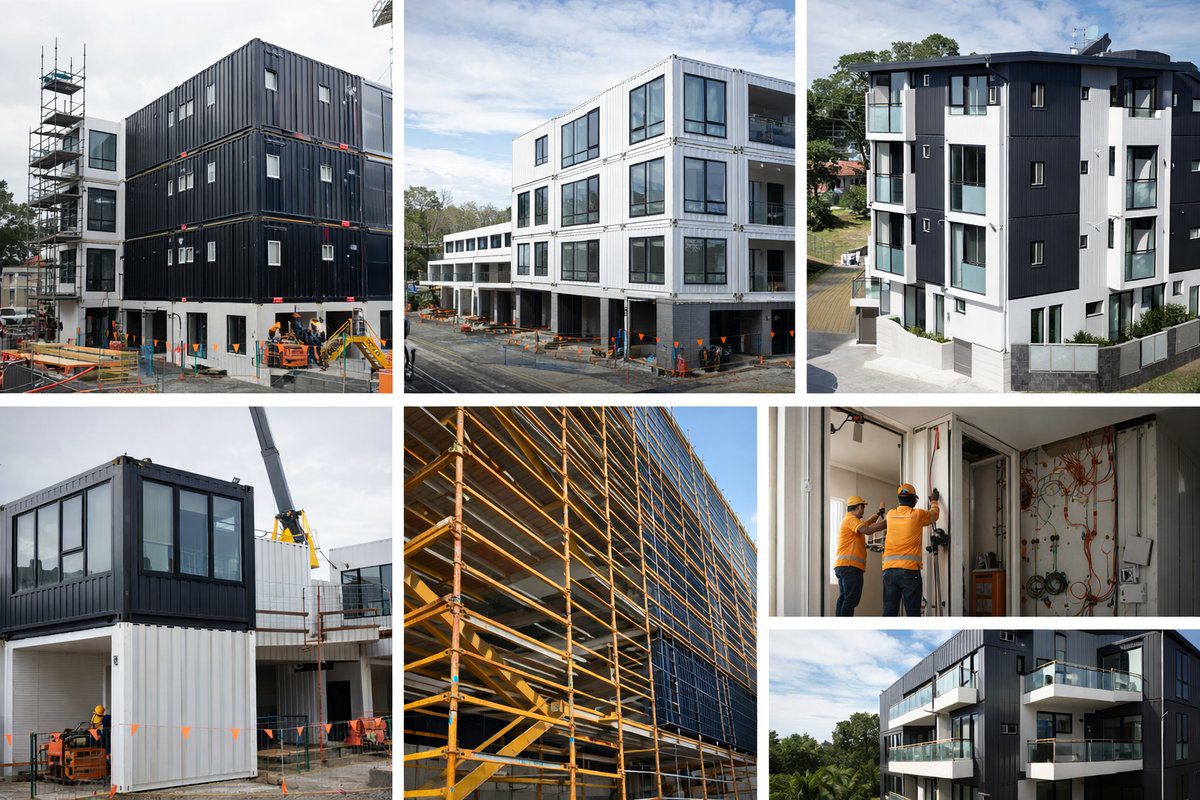
Workforce accommodation demand in the Pilbara has stepped up materially in 2026. Perdaman’s urea project at Karratha is anchoring a fresh land-release-led housing push of around 133 homes through Karratha-based builders. The Western Australia government has run two parallel modular-build tender pathways (DOC9621321 and DOC9631322) inside six weeks of each other — a clear signal that procurement teams want offsite-fabricated supply with engineered compliance. For builders pricing dongas, single-person quarters (SPQ), 2-bedroom couples units, or family workforce villages in Karratha, Port Hedland, Dampier or Newman, modular structural-steel supply is the path that closes a programme inside one budget cycle.
This guide breaks down the cost benchmarks, NCC compliance stack, cyclone-rated structural requirements, transport and crane logistics, and the supply model that lets a Karratha or Pilbara builder lock price and programme certainty before site mobilisation.
Why modular for Karratha and Pilbara workforce accommodation
Three structural pressures push Pilbara workforce projects toward modular supply rather than stick-built construction:
- Trade scarcity. Karratha, Port Hedland and Newman compete for the same labour pool as resource majors. On-site framing, fit-out and services trades carry premiums of 25 to 40 percent above metro Perth. Offsite fabrication moves 70 to 80 percent of trade hours into a controlled facility.
- Programme compression. Workforce accommodation typically funds against a project-start date that is fixed by the resources operation. Traditional construction in Karratha runs 12 to 16 months for a 30 to 60-bed facility; modular delivers the same in 5 to 7 months from design lock.
- Cyclone exposure. The Pilbara sits in NCC Wind Region D — the most demanding cyclone-rated category in Australia. Structural-steel modular volumes engineered against C3 to C4 ratings ship with the rated structure already in place, removing the risk of on-site framing failures during the build and shoulder seasons.
Cost benchmarks: workforce accommodation Karratha and Pilbara 2026
Supply-only modular pricing for workforce accommodation in WA breaks down by typology. These benchmarks reflect structural-steel volumetric supply from EcoPrestige’s 50,000m² in-house production facility — turnkey, fully pre-cladded modules with services rough-ins complete — delivered DAP Port Hedland or Dampier (excludes GST, foundations, site works and installation).
| Typology | Module size | Supply $/m² (excl GST) | Indicative delivered |
|---|---|---|---|
| Single Person Quarters (SPQ) | 16–20m² ensuite room | $2,400–$3,200 | $48,000–$72,000 per room |
| Couples / 1BR (Orchid 42m²) | 1 bedroom + kitchen + bath | $2,300–$2,800 | $96,000–$135,000 per unit |
| 2BR family (Tulip 59m²) | 2 bedroom + living + bath | $2,300–$2,700 | $135,000–$180,000 per unit |
| 3BR family (Acacia 84m²) | 3 bedroom + living + 2 bath | $2,300–$2,600 | $195,000–$240,000 per unit |
| Mess / kitchen / amenities | Bespoke (60–200m²) | $3,000–$4,500 | By design |
For comparison, conventional Pilbara construction for the same typologies runs 35 to 55 percent higher on a delivered $/m² basis once site labour premiums, demobilisation and weather-related programme extensions are priced in. On a 60-bed SPQ village, modular supply commonly delivers $4M to $7M of cost saving against traditional site-built — before counting the revenue or operational uplift from earlier occupancy.
NCC compliance: cyclone-rated structural steel for Region D
Karratha, Port Hedland, Dampier, Onslow and Newman sit inside NCC Wind Region D. Workforce accommodation modular supply for these locations must be engineered to the following stack:
- NCC Class 1b (boarding house / SPQ): fire separation, smoke alarms, accessibility provisions where applicable.
- NCC Class 3 (residential workforce camps and longer-stay villages): full Class 3 fire compartmentation, Section J energy efficiency.
- AS 1170.2 Wind Region D: structural design wind speed up to VR 88 m/s; cyclone debris impact rated.
- AS 3959 BAL as applicable for vegetation interface zones (parts of the Pilbara are BAL-12.5 to BAL-29).
- NCC Section J: thermal envelope sized for Climate Zone 1 (hot humid) — insulation, glazing and HVAC selection are the cost drivers.
- Evidence of Suitability under NCC A5.2: each module ships with engineering certification, fire test reports for compartmentation, and CodeMark or equivalent assessment for structural systems.
The compliance package is the single biggest reason WA builders increasingly insist on modular supply with documented Evidence of Suitability rather than light-frame portable buildings. Light-frame portables typically struggle to meet Region D cyclone ratings without significant on-site re-engineering, which erases the speed advantage. Structural-steel volumetric modules ship pre-rated.
Logistics: Port Hedland, Dampier and Karratha delivery
Pilbara workforce projects sit between two logistics corridors. Both work for modular supply, with selection driven by destination town and crane availability:
- Port Hedland Port: deep-water container terminal — preferred for projects in Port Hedland, South Hedland and Newman (via Great Northern Highway). Container roll-off from vessel to truck adds two to four days to programme.
- Dampier Port: bulk terminal with break-bulk capacity — preferred for Karratha, Wickham and Roebourne. Shorter overland leg (less than 40 km to most Karratha sites). Crane lift windows align well with morning calm conditions.
- Module sizing: standard transport envelope is 12.0m × 4.0m × 3.4m (single trailer, no over-dimension permits). Larger envelopes (up to 16m × 5.0m) trigger oversize escort permits and cyclone-season blackouts.
- Cyclone season window: November to April carries elevated cyclone risk and port closure days. Programme delivery into the May to October window where possible. EcoPrestige factory-stages modules pre-shipping to align with safe-window arrivals.
Worked example: 60-bed Karratha SPQ village
A representative 60-bed single-person-quarters village for a Karratha resources or construction-services operator runs as follows:
- Built form: 60 SPQ rooms (16m² ensuite each) across three single-storey wings; central mess/amenities block (180m²); ablutions and laundry (90m²).
- Total NLA: ~1,230m².
- Modular supply DAP Dampier (excl GST): $3.4M to $4.1M.
- Site works, foundations, install, services connection: $1.6M to $2.2M (builder scope).
- All-in delivered programme: 6 to 7 months from design lock to practical completion.
- Traditional comparator: $7.8M to $9.6M, 13 to 16 months — modular saves $2.5M to $3.4M and 7 to 9 months.
Scope split: builder vs modular supplier
EcoPrestige operates as a builder-facing modular systems supplier. We do not compete with the head contractor — we sit underneath. The clean scope split for a Pilbara workforce project is:
- Builder / head contractor: site survey, civils, foundations and pad design, services trenching to module footprint, crane and traffic management, install supervision, statutory authority approvals, services commissioning, occupancy certificate.
- EcoPrestige (modular supply): shop drawings, structural and fire engineering, factory fabrication, internal fit-out and pre-cladding, services rough-ins (electrical, plumbing, HVAC), Evidence of Suitability documentation, delivery DAP nominated WA port.
- Optional EcoPrestige extensions: install supervision, full installation as a sub-contract package, or D&B coordinator role under AS 4300 for projects where the builder wants single-point delivery accountability.
This split is what protects the builder’s programme. The modular supplier carries factory risk; the builder carries site risk; neither side carries cross-trade exposure they cannot control.
Common Pilbara workforce accommodation pitfalls
- Specifying light-frame portables for Region D. Standard portables are not engineered for cyclone wind speeds without retrofit. Structural-steel volumetric is the correct base specification.
- Underestimating port-cycle programme impact. Cyclone-season closures can delay arrivals by two to six weeks. Factory-stage to ship pre-November.
- Specifying Class 1a residential for a workforce camp that should be Class 1b or 3. Wrong class triggers re-design and re-certification once the operator’s compliance team reviews.
- Undocumented connection details between modules. Pilbara wind loads concentrate at module-to-module joints. Demand engineered connection drawings and cyclone-rated tie-down details on day one.
- Single-source crane assumption. Karratha has finite mobile-crane capacity. Lock crane allocation when modules leave factory, not on arrival at port.
FAQ
How long does modular workforce accommodation take to deliver in Karratha?
Five to seven months from design lock to practical completion for a 30 to 60-bed village. Design and engineering: 6 to 8 weeks. Factory fabrication: 10 to 14 weeks. Shipping and customs: 2 to 4 weeks. Install and commissioning: 4 to 6 weeks. Pilbara traditional construction for the same brief is 13 to 16 months.
Is modular workforce accommodation cyclone-rated for the Pilbara?
Yes — structural-steel volumetric modular is engineered against AS 1170.2 Wind Region D and rated to C3 or C4 cyclone categories. Each module ships with structural engineering certification and Evidence of Suitability under NCC A5.2. Light-frame portables are typically not Region D rated without retrofit.
What does modular workforce accommodation cost per room in the Pilbara?
Single-person-quarters rooms run $48,000 to $72,000 delivered ex-port. 1-bedroom couples units $96,000 to $135,000. 2-bedroom family units $135,000 to $180,000. 3-bedroom family units $195,000 to $240,000. These are supply-only DAP Port Hedland or Dampier; foundations, site works and install are builder scope.
Can modular workforce villages be expanded later?
Yes. Structural-steel volumetric modules are designed to accept staged expansion — additional wings, mess upgrades, and overflow rooms can be installed without disturbing operating accommodation, provided the original civils were sized for the staged footprint. Plan stage two on day one.
Does EcoPrestige hold WA building approvals?
Modular structural and fire engineering is performed by Australian-registered engineers; Evidence of Suitability documentation is provided per NCC A5.2 to support the builder’s WA building permit application. The head contractor remains the licensed WA builder of record.
Next step for Karratha and Pilbara builders
If you are pricing a Karratha, Port Hedland, Dampier or Newman workforce project for 2026 mobilisation — whether driven by the Perdaman housing pipeline, the WA modular-build tender pathways, or a private resources operator brief — the cleanest path is a 30-minute review of your scope, programme and site plan. EcoPrestige supplies a fixed-price modular indication, scope split and engineered compliance pathway in five working days. Send us your project brief or download the EcoPrestige product brochures for the Orchid, Tulip and Acacia model specifications.
Programme-aligned guides for 2026: Rio Tinto $100M Pilbara / Sodexo channel-partner and BHP $50M Port Hedland programme.