
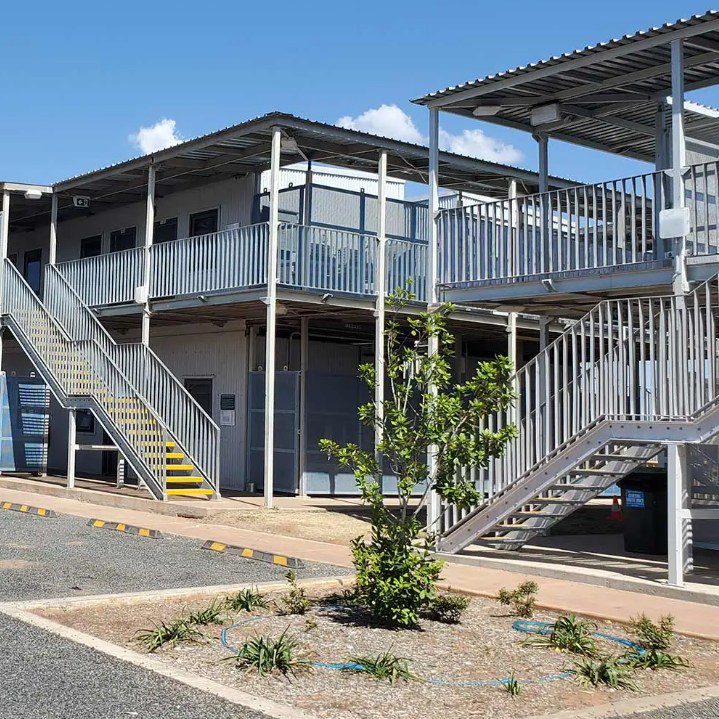
Remote and regional Australian projects — mining camps, windfarm construction quarters, agricultural workforce, remote-area government facilities — share a common problem. Traditional build programmes collapse against remote logistics, trade scarcity, and FIFO-cost overhead. Modular solves three of these at once. This guide is a practical buyer’s framework for workforce-accommodation procurement in 2026.
Why workforce accommodation is a modular-first category
- Typologies are repeatable — single-person quarters (SPQ 16–20m²), dongas, dining/ablution blocks.
- Sites are often tenure-limited — camp must demobilise at project end. Modular is relocatable.
- Trades are scarce at site — shifting labour into a factory reduces site FIFO cost.
- Sequence is brutal — first crew on site needs first modules on day one of construction. A 14–18 month traditional build cannot meet this.
The three cost buckets
Supply: $1,800–$3,200/m² for modular SPQ / donga equivalent. Significantly under traditional remote build rates once FIFO overhead is loaded.
Transport + install: Variable. Pilbara, Bowen Basin, Cooper Basin, Kimberley each have different heavy-vehicle permit and port logistics. Budget 15–25% of supply value for remote logistics.
Site services + commissioning: Power, water, waste, sewer, internet. Commonly 20–30% of total programme cost on remote sites.
Compliance considerations
NCC Class 1b (short-stay accommodation) or Class 3 (medium-term accommodation) depending on camp duration. Cyclone ratings C3/C4 for Pilbara, Kimberley, Top End. BAL rating for bushfire-interface sites. Fire egress, acoustic, accessibility (AS 1428) all required in factory.
Indicative programme — 60-bed camp, greenfield remote site
Design lock: 4–6 weeks. Factory manufacture: 12–14 weeks. Shipping (Qingdao → Fremantle/Dampier/Darwin): 3–4 weeks. Site install: 4–6 weeks. Commissioning: 2–3 weeks. Total ~6–8 months. Traditional equivalent: 14–18 months.
Typology briefing for decision-makers
SPQ cluster: 10-12 SPQs per block sharing central ablution + drying room. Best for long-duration camps.
Shared-ablution donga rows: Lower cost, shorter-duration camps, higher turnover acceptable.
Family/two-person modules: Regional agricultural and government workforce. 25–30m², 1BR + kitchenette.
Dining + recreation: 100–400 seat dining, separate recreation, gym, laundry, central kitchen.
Procurement reality
Tier-1 mining and resource majors often have incumbent camp suppliers (Fleetwood, ATCO). The opportunity for a builder-facing supplier like EcoPrestige is in the mid-tier: Tier-2 contractors, regional councils, agricultural workforce operators, government-infrastructure contractors who need modular but don’t want to work directly with Tier-1 camp incumbents.
FAQ
How quickly can modular workforce accommodation arrive on site?
From design lock, typically 6–8 months to first modules on site. The critical path is the 3–4 week shipping plus 4–6 week install sequence; factory manufacture runs in parallel with shop-drawing approval.
What about remote communication, power and water?
Supply-only scope excludes site services. Head builder or the camp operator coordinates power (diesel gen-sets, solar-hybrid, or grid tie-in), water (bore + treatment, or carted), waste (treatment plant), and comms (Starlink or cellular).
Can modules be relocated between sites?
Yes — structural-steel chassis design is relocatable. Depreciation and transport costs are typically 10–15% of module value per move.
Download our workforce-accommodation brochures: ecoprestige.com.au/brochures. Start a project scoping conversation: ecoprestige.com.au/contact.
Related: WA mining camp guide · Accommodation · WA hub · NT hub · QLD hub